
Thursday, December 28, 2006

Friday, December 22, 2006
Sunday, December 03, 2006
Tuesday, November 28, 2006
Israeli Map Says West Bank Posts Sit on Arab Land
 An Israeli advocacy group, using maps and figures leaked from inside the government, says that 39 percent of the land held by Israeli settlements in the occupied West Bank is privately owned by Palestinians.
Israel has long asserted that it fully respects Palestinian private property in the West Bank and only takes land there legally or, for security reasons, temporarily.
If big sections of those settlements are indeed privately held Palestinian land, that is bound to create embarrassment for Israel and further complicate the already distant prospect of a negotiated peace. The data indicate that 40 percent of the land that Israel plans to keep in any future deal with the Palestinians is private.
The new claims regarding Palestinian property are said to come from the 2004 database of the Civil Administration, which controls the civilian aspects of Israel’s presence in the West Bank. Peace Now, an Israeli group that advocates Palestinian self-determination in the West Bank and Gaza Strip, plans to publish the information on Tuesday. An advance copy was made available to The New York Times.
The data — maps that show the government’s registry of the land by category — was given to Peace Now by someone who obtained it from an official inside the Civil Administration. The Times spoke to the person who received it from the Civil Administration official and agreed not to identify him because of the delicate nature of the material.
Read More!
Tuesday, November 14, 2006
Two Memorable Quotes
Spiegel Interview With Richard Haass:Haaretz reports Israeli Prime Minister Ehud Olmert came to Washington and said this to Bush about Iraq:
The old Middle East -- an era which I believe has only recently ended -- was one in which the United States enjoyed tremendous dominance and freedom of maneuver. Oil was available at fairly low prices, the region was largely at peace. I believe largely because of the American decision to go to war in Iraq and how it has been carried out, as well as the emphasis on promoting democracy and a lack of any serious energy policy, the Middle East has considerably grown worse. It's one of history's ironies that the first war in Iraq, a war of necessity, marked the beginning of the American era in the Middle East and the second Iraq war, a war of choice, has precipitated its end.
We in the Middle East have followed the American policy in Iraq for a long time, and we are very much impressed and encouraged by the stability which the great operation of America in Iraq brought to the Middle East. We pray and hope that this policy will be fully successful so that this stability which was created for all the moderate countries in the Middle East will continue.
Tuesday, October 10, 2006
Tuesday, October 03, 2006
Kofi Annan Will Be Missed
 In Defense of Kofi Annan, United Nations Secretary-General (1997-2006)
Over Darfur, Kofi Annan has been far stronger than his predecessor was about Bosnia or, indeed, Rwanda -- to which, of course, Annan was not unconnected himself. Annan has gone way beyond normal diplomatic protocol in chiding Khartoum and calling for international action. The U.N. reports have been unequivocal in their condemnation of Sudanese government behavior. But in the end, it was the United States that blinked and went to Khartoum with carrots rather than sticks.
If the big powers persist in speaking very loudly while carrying a very small and light stick, it is not the U.N.'s fault -- though it’s always been used as a scapegoat.
A further irony is that one of the reasons for their attacks on Annan is his success in walking the diplomatic tightrope strung between insufferable American behavior and the U.N.’s genuine need to engage with Washington and to maintain a prestigious profile with the American public. All U.N. secretaries-general have had to pander to the great powers. Annan was left with only one to pander to.
 They are not attacking Annan; they are attacking any form of multilateralism, whether the Land Mine Treaty, non-proliferation, the International Criminal Court, or even the Geneva Conventions (all of which he has publicly supported). They were not even attacking the oil-for-food program; they were attacking an organization that dared to say no -- or, at least, refused to say yes -- to Bush's war on Iraq.
Lord Hannay, Britain's ambassador to the UN from 1990 to 1995, says member states are "ruthless" at manipulating the UN.
They go about blaming the UN for things that are actually their responsibility - but they go far too far in acquitting themselves.James Rubin, a senior American diplomat at the time, believes the lesson is that any secretary general must get on with the US to succeed.
Managing the United States is the single indispensable of being an effective secretary general. It doesn't mean agreeing with the United States, but it does mean managing the United States.Sir Marrack Goulding, ex-Deputy Secretary General of the United Nations, assessed the role of the Secretary-General:
It's also true that the United States does not happen to be very popular in the world right now. Since the UN is made up of member states, and most of those member states now do not happen to be very pleased with US foreign policy, you have to be able to manage this great power, but also do it in a way that doesn't make the majority of your members feel as if you're buckling under all the time."
If major countries in the world aren't prepared to do something, the UN isn't going to be able to do it either.
If people understood that, they would be less disappointed by the chief diplomat of the United Nations.
This is not a position of power; this is not a man who can lay down the law.For much of the world, it is the conservative bullies in the US who see the UN as an after-sales service complex for American misadventures. On Iraq, Iraq, Annan never buckled. When he was asked outright if the war was illegal Annan replied:
But he does have huge influence, and he has a 'bully pulpit'. He can tell the world that they really have to get to grips with whatever it might be - Aids, the environment. Kofi Annan in particular has made a great deal of that influence.
I think we shouldn't understate the importance of the role. If you put into it someone who couldn't communicate properly, you'd be missing a lot of tricks.
If major countries in the world aren't prepared to do something, the UN isn't going to be able to do it either.
If people understood that, they would be less disappointed by the chief diplomat of the United Nations.
Yes, if you wish.
I have indicated it was not in conformity with the UN charter. From our point of view and from the charter point of view it was illegal.
Sunday, October 01, 2006
Disclosures by Bob Woodward
 Bob Woodward's State of Denial: Bush at War, Part III
Bush 'kept Blair in the dark over Iraq'
Prime Minister Blair repeatedly complained to Bush after discovering Britain was being denied access to key information on the grounds that it was a 'foreign' nation.
The attempt to bluff the Prime Minister involved a highly class-ified database called the Secret Internet Protocol Router Network (SIPRNET) which the Pentagon used to store and communicate years of potentially embarrassing intelligence, as well as technical information about combat operations in Iraq. Woodward adds,
In July 2004, Bush assured Blair he had signed a directive saying the NOFORN rule would no longer apply to the British on military operations.
The classified information had a caveat - NOFORN - meaning no foreigners were allowed access, a restriction that included even the British troops fighting alongside Americans in Iraq,'
The Pentagon ignored it, hatching a scheme to hoax the British into believing they were being kept fully informed.
Saturday, September 23, 2006
Osama bin Laden Is Dead?
 An image taken from an internet posting by al Qaeda's media arm, al Sahab on September 11, 2006, shows Osama bin Laden speaking in an unknown location.
REUTERS/Internet
The information defused this morning by the l'Est Republicain newspaper concerning the possible death of Osama bin Laden cannot be confirmed.The daily newspaper for the Lorraine region in eastern France printed what it described as a confidential document from the French foreign intelligence service DGSE (or Direction Generale des Services Exterieurs) citing an uncorroborated report from Saudi secret services that the leader of the al-Qaida terror network had died.
The contents of the document, dated Sept. 21, or Thursday, were not confirmed by French or other intelligence sources. However, the DGSE transmitted the note to President Jacques Chirac and other officials, the newspaper said.
Defense Minister Michele Alliot-Marie "has demanded an investigation be carried out of this leak," a ministry statement said, adding that transmission of the confidential document couldrisk punishment.
Defense Ministry spokesman Jean-Francois Bureau, clarifying the statement, said that the DGSE document exists but that its contents - that bin Laden is allegedly dead - cannot be confirmed.
The DGSE report indicated that its information came from a single source.
According to a reliable source, Saudi security services are now convinced that Osama bin Laden is dead. . . . . The chief of al Qaeda was a victim of a severe typhoid crisis while in Pakistan on August 23, 2006There have been periodic reports of bin Laden's illness or death in recent years but none has been proven accurate.
According to this document, Saudi security services were pursuing further details, notably the place of his burial . . . . The chief of al Qaeda was a victim of a severe typhoid crisis while in Pakistan on August 23, 2006.
According to the Scotsman, (Reuters):
L'Est Republicain, published a report quoting a French secret service report on 21 September quoted French authorities:
The information published this morning in the L'Est Republicain newspaper relating to the supposed death of Osama bin Laden cannot be confirmed.
The Defence Minister (Michele Alliot-Marie) has asked that an inquiry be carried out to determine the origin of the leak that can be punished by criminal charges."
According to a usually reliable source, the Saudi services are now convinced that Osama bin Laden is dead.
The information gathered by the Saudis indicates that the head of al Qaeda was a victim while he was in Pakistan on August 23, 2006, of a very serious case of typhoid which led to a partial paralysis of his internal organs.
Saturday, September 09, 2006
Blood Borders
How a better Middle East Would Look


Below are my excerpts with boldfacing added from The Armed Forces Journal.
Peter says the point of this exercise is not to draw maps as we would like them but as local populations would prefer them. Peters writes that the


by Ralph Peters
Below are my excerpts with boldfacing added from The Armed Forces Journal.
Peter says the point of this exercise is not to draw maps as we would like them but as local populations would prefer them. Peters writes that the
degree of injustice they inflict upon those whom frontiers force together or separate makes an enormous difference — often the difference between freedom and oppression, tolerance and atrocity, the rule of law and terrorism, or even peace and war.
. . . . The most arbitrary and distorted borders in the world are in Africa and the Middle East.
. . . . But the unjust borders in the Middle East — to borrow from Churchill — generate more trouble than can be consumed locally.
. . . . While the Middle East has far more problems than dysfunctional borders alone — from cultural stagnation through scandalous inequality to deadly religious extremism — the greatest taboo in striving to understand the region's comprehensive failure isn't Islam but the awful-but-sacrosanct international boundaries worshipped by our own diplomats.
. . . . no adjustment of borders, however draconian, could make every minority in the Middle East happy. In some instances, ethnic and religious groups live intermingled and have intermarried. Elsewhere, reunions based on blood or belief might not prove quite as joyous as their current proponents expect. The boundaries projected in the maps accompanying this article redress the wrongs suffered by the most significant "cheated" population groups, such as the Kurds, Baluch and Arab Shia, but still fail to account adequately for [others].
. . . . Even those who abhor the topic of altering borders would be well-served to engage in an exercise that attempts to conceive a fairer, if still imperfect, amendment of national boundaries. . . . a mental effort to grasp the Middle East's "organic" frontiers nonetheless helps us understand the extent of the difficulties we face and will continue to face.
. . . . it pays to remember that boundaries have never stopped changing through the centuries. Borders have never been static,
Oh, and one other dirty little secret from 5,000 years of history: Ethnic cleansing works.
Begin with the border issue most sensitive to American readers: For Israel to have any hope of living in reasonable peace with its neighbors, it will have to return to its pre-1967 borders — with essential local adjustments for legitimate security concerns. But the issue of the territories surrounding Jerusalem, a city stained with thousands of years of blood, may prove intractable beyond our lifetimes. Where all parties have turned their god into a real-estate tycoon, literal turf battles have a tenacity unrivaled by mere greed for oil wealth or ethnic squabbles.
. . . . The most glaring injustice in the notoriously unjust lands. . . . is the absence of an independent Kurdish state. . . . the Kurds the world's largest ethnic group without a state of its own.
A just alignment in the region would leave Iraq's three Sunni-majority provinces as a truncated state that might eventually choose to unify with a Syria that loses its littoral to a Mediterranean-oriented Greater Lebanon: Phoenecia reborn. The Shia south of old Iraq would form the basis of an Arab Shia State rimming much of the Persian Gulf. . . .
. . . . the unnatural state of Saudi Arabia would suffer as great a dismantling. . . . imagine how much healthier the Muslim world might become were Mecca and Medina ruled by a rotating council representative of the world's major Muslim schools and movements in an Islamic Sacred State — a sort of Muslim super-Vatican — where the future of a great faith might be debated rather than merely decreed. True justice — which we might not like — would also give Saudi Arabia's coastal oil fields to the Shia Arabs who populate that subregion. . . .
Iran, a state with madcap boundaries, would lose a great deal of territory to Unified Azerbaijan, Free Kurdistan, the Arab Shia State and Free Baluchistan, but would gain the provinces around Herat in today's Afghanistan — a region with a historical and linguistic affinity for Persia. Iran would, in effect, become an ethnic Persian state again. . . .
What Afghanistan would lose to Persia in the west, it would gain in the east, as Pakistan's Northwest Frontier tribes would be reunited with their Afghan brethren. . . .
Pakistan, another unnatural state, would also lose its Baluch territory to Free Baluchistan. The remaining "natural" Pakistan would lie entirely east of the Indus, except for a westward spur near Karachi.
. . . . studying the revised map, in contrast to the map illustrating today's boundaries, offers some sense of the great wrongs borders drawn by Frenchmen and Englishmen in the 20th century did to a region
Correcting borders to reflect the will of the people may be impossible. For now. But given time — and the inevitable attendant bloodshed — new and natural borders will emerge. Babylon has fallen more than once.
Meanwhile, our men and women in uniform will continue to fight for security from terrorism, for the prospect of democracy and for access to oil supplies in a region that is destined to fight itself.
. . . . taken together with the region's self-inflicted woes, form as perfect a breeding ground for religious extremism, a culture of blame and the recruitment of terrorists as anyone could design. Where men and women look ruefully at their borders, they look enthusiastically for enemies.
Tuesday, September 05, 2006

Sunday, September 03, 2006
Civil War in Iraq
03-Sept-06
Grand Ayatollah Ali al-Sistani is angry and disappointed that Shias are ignoring his calls for calm and are switching their allegiance in their thousands to more militant groups which promise protection from Sunni violence and revenge for attacks:
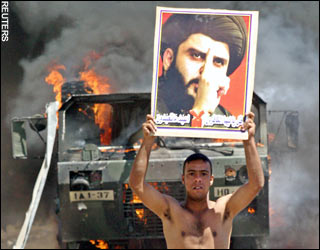
Grand Ayatollah Ali al-Sistani is angry and disappointed that Shias are ignoring his calls for calm and are switching their allegiance in their thousands to more militant groups which promise protection from Sunni violence and revenge for attacks:
I no longer have power to save Iraq from civil war... I will not be a political leader any more. I am only happy to receive questions about religious matters.Al-Sistani's aides say that he has chosen to stay silent rather than suffer the ignominy of being ignored. Moqtada Al Sadr's stock has risen. A spokesman, Sheik Hussein al-Aboudi, says,
He meets his representatives every week or every day. Sistani only meets his representatives every month.Sistani's departure from Iraq's political scene and his return to his religious role signals an end to the Maliki regime's attempt to consolidate power and sell his reconciliation plan to the myriad of warring factions who are engaged in armed and deadly struggles against his regime, and against each other as well. It was Sistani who brought the thousands of his followers to the polls, forcing Bush to make good on his promise of early elections.
Muqtada al-Sadr asks them what the situation is on the street, are there any fights against the Shia, he is asking all the time. So the people become close to al-Sadr because he is closer to them than Sistani. Sistani is the ayatollah, he is very expert in Islam, but not as a politician.
Cross-posted in Civil War In Iraq
Godwin's Law & Corollary
Steve Chapman, Iraq isn't Hitler's Third Reich:
Among the many innovations generated by the Internet is an axiom called Godwin's Law, which says that given enough time, any online discussion will produce a comparison involving Nazism or Hitler. So common is this phenomenon in cyberspace arguments that it also spawned an informal rule: Whoever first mentions the Nazis loses.
By that standard, the Bush administration is getting trounced in the debate on Iraq. Last week, Defense Secretary Donald Rumsfeld went to the American Legion convention and likened critics of our policy to those who discounted the threat posed by Nazism. The threat of "a new type of fascism," he said, is just as great as the one posed by Hitler and Mussolini.
President Bush followed with his own address to the Legionnaires, asserting that the fighting in Iraq "can be as fierce as it was at Omaha Beach or Guadalcanal," while insisting that "victory is as important as it was in those earlier battles."
The administration's top officials have been a poor guide to the future: Rumsfeld said before the war that it might go on for "five days or five weeks or five months, but it certainly isn't going to last any longer than that." They have been a poor guide to the present, as when Vice President Dick Cheney declared--about 1,000 American deaths ago--that we were seeing "the last throes, if you will, of the insurgency." And, judging from their recent forays into history, they are a poor guide to the past.
One defect in this analogy is that it's extremely shopworn. No matter how many Hitlers we stop, another appears. During the first Gulf War in 1991, it was Saddam Hussein. During the Balkan wars of the '90s, it was Yugoslavian President Slobodan Milosevic. Now it's--well, anyone Islamic who might be an enemy.
Rather than try to understand the unique challenges we face in the 21st Century, the analogizers assume they are replicas of ones we have confronted before. Such glib parallels bring to mind Mark Twain's remark: A cat that sits on a hot stove will never again sit on a hot stove, but it will also never sit on a cold one.
The supposed moral of the 1930s is that you cannot negotiate or coexist with enemies. Instead, you must fight them. Anything less amounts to a replay of the Munich conference, where Britain and France acceded to Hitler's claims on Czechoslovakia in a futile effort to purchase peace.
But we already know the analogy can be fatally misapplied. President Lyndon Johnson was guided by it during the Vietnam War. When the North Vietnamese won, though, it didn't set off a vast expansion of the communist empire. Ho Chi Minh looked like Hitler to LBJ, but he wasn't.
If the 1930s taught that you can't coexist with aggressive enemies, the Cold War taught just the opposite. Britain and the United States, which refused to appease Hitler, did appease Stalin by allowing the enslavement of Eastern Europe. Yet we were able to contain--and eventually defeat--the Soviets without ever going to war.
You don't have to take my word that Hitler is irrelevant here. The administration's own policies confirm as much. If the enemy in Iraq were comparable to the Third Reich, we certainly wouldn't be fighting this war the way Bush and Rumsfeld have fought it.
When the U.S. entered the war against the Axis powers, we drafted millions of men, raised taxes, and mobilized every resource to assure victory. When the U.S. invaded Iraq, we sent an undersized force, cut taxes and told Americans to live their normal lives. If Islamic extremists are the new Nazis, Bush is no Churchill.
In fact, the situation today is much different from the one then. Militant Islam is not one phenomenon but many. Iraqi Shiites and Sunnis, far from being peas in a pod, are at war with each other. You can't barter with Osama bin Laden, but you may be able to negotiate with Syria. Persisting with the war in Iraq is less likely to undermine than advance the fight against Al Qaeda.
Given the dire prospects in Iraq, it's not surprising that Bush and Rumsfeld would rather talk about the past than the present. But we already know how to defeat Hitler. What the administration has yet to prove is that it knows how to win in Iraq.
Monday, August 28, 2006
Questions and Answers on Troop Deployments
Why Involuntary Call-Ups in All-Volunteer Military?
The Marine Corps announced plans last week for involuntary call-ups of Marine reservists to serve in Iraq and Afghanistan. Here's a Q & A to give you a low-down on the implications:
Question: Who's getting called up?
Question: Do some volunteer for this duty?
Question: Why not fill all the openings with volunteers?
Question: The Pentagon has said it's meeting its recruiting goals. So how can there be a shortage of Marines?
Question: How many others were given no choice?
Question: Is this like a military draft?
The Marine Corps announced plans last week for involuntary call-ups of Marine reservists to serve in Iraq and Afghanistan. Here's a Q & A to give you a low-down on the implications:
Question: Who's getting called up?
Those who stand to be summoned are Marines who recently have completed four years of active duty and are serving the remaining years of their eight-year service commitment in a reserve program known as the "individual ready reserve."Question: Do all Marines go from active duty to the individual ready reserve?
No. Some join reserve units that have monthly drills. Some remain attached as reservists to active-duty units. About 59,000 are in the individual ready reserve. They are not attached to reserve or active-duty units but are available as individuals to volunteer or be called up for duty in units that have vacancies.Question: How many will be called up?
The Marines estimate there are 1,200 jobs that may need to be filled on an involuntary basis. Call-up guidelines allow commanders to summon up to 2,500 Marines and to subsequently call up additional groups of 2,500.
Question: Do some volunteer for this duty?
Yes. The Marines regularly post newly created jobs or jobs that have become vacant because of casualties or discharges and encourage members of the individual ready reserve to volunteer. They are paid for the duty.
Question: Why not fill all the openings with volunteers?
The Marine Corps would prefer to do that. But the number of volunteers has been declining, and the commitment of troops in Iraq and Afghanistan has remained constant. So commanders foresee a time when they have openings near the front lines and no Marines available to fill them.
Question: The Pentagon has said it's meeting its recruiting goals. So how can there be a shortage of Marines?
The Marines have been meeting their recruiting goals (the Army missed its goal last year; the National Guard and Army and Navy reserves are struggling this year).Question: Weren't the number of troops in Iraq supposed to go down this year?
However, when a unit is serving in combat and Marines are killed or wounded, commanders can't fill those jobs by simply moving Marines from other units, because that would create new vacancies. Instead, they call for help from reserves.
Up until now, that call has been answered by volunteers.
Yes. Since early 2005, top commanders have predicted that "substantial reductions" in the numbers of U.S. forces would occur in 2006. President Bush expressed a similar hope in his State of the Union speech in January. But persisting violence has prevented commanders from going ahead with withdrawals.Question: How many troops do we have over there?
As of last week, there were 138,000 U.S. troops in Iraq, including about 22,000 Marines.Question: Bush administration officials talk about the all-volunteer force. Are the troops in Iraq all volunteers?
They all voluntarily joined the military. But as in the case of the Marines in the individual ready reserve, many had little or no choice about going to Iraq.
Question: How many others were given no choice?
It's difficult to say for sure. The Army tapped its individual ready reserve in 2004, mobilizing about 5,000 inactive soldiers. About 2,200 Army ready reservists continue to serve, about 1,850 of them involuntarily.
In addition, many military units have been held in Iraq beyond their scheduled tours. While the Pentagon could not provide exact current numbers of troops affected by such extensions, there were more than 13,000 in Iraq at the end of last year.
Viewed another way, however, when the Pentagon mobilizes and deploys an entire military unit, its members do not necessarily have a choice to go or stay, either. The difference is that some are sent to Iraq, or kept there, through variations on normal deployments.
Question: Is this like a military draft?
Some call it a "backdoor draft." But the United States abolished compulsory military service in 1973, moving to an all-volunteer military based on recruiting.Question: We have 138,000 troops in Iraq, and Defense Secretary Donald H. Rumsfeld says there are 2 million available. So why does the military seem to be under strain?
Still, by adapting the rules to send people to Iraq who didn't expect to go, or to keep people there longer than they expected, commanders are stirring up some hard feelings among service members and their families.
The 2 million includes all the active-duty services, reserves and National Guard. But the fighting in Iraq and Afghanistan has fallen heavily on the Army, which has about 500,000 members worldwide, and the Marines, with 179,000.When Army recruiting numbers plummeted last year, commanders tweaked standards and recruitment procedures, such as bait and switch, intimidation, and unprecedented signing bonuses.
Nearly eight out of every 10 members of the Army and Marines have served in Iraq and Afghanistan, many of them more than once. Army rules tend to limit combat deployments to a year; Marines send their members to fight for seven months. With the war in its fourth year, nearly a third have been deployed more than once.
Sunday, August 27, 2006
The Bush Administration Must Make Iran An Offer It Can't Refuse
Says Trudy Rubin:
Philadelphia Daily News
The negotiating process with Iran has been haunted from the start by a basic contradiction in American policy. The White House can't decide what is its highest priority: changing Iranian behavior or changing the regime.
The Bush team has been unwilling to offer the one carrot that could make Iran reconsider its actions: assurance that America will not undermine or attack the Iranian regime. In return, Iran would have to freeze its nuclear program and stop destabilizing the region - and halt its aggressive posturing toward Israel.
The White House has steadfastly refused to offer any such deal.
In 2003, when America was newly triumphant from the Afghan war, Iran conveyed an interest in a "grand bargain" that included acceptance of a two-state solution to the problem of Israel and the Palestinian territories. The White House wasn't interested.
In spring 2006, Tehran sent numerous signals that it wanted talks, including the first public endorsement of the idea by Iran's supreme leader, Ayatollah Khamenei. (By the way, in Iran's system, Khamenei, not Ahmadinejad, controls foreign and nuclear policy.)
When I was in Iran in May, Iranian officials bombarded me with the message that America needed their country's cooperation for stability in the Middle East. The intensity of the message convinced me that America had bargaining chips that Iranian officials badly wanted - recognition of their regime and acceptance of their economic and political role in the region.
Iran's interest in talks waned in late spring, when the West's negotiating proposal offered no hint of American security pledges. Iran was required to suspend all nuclear enrichment activities as a precondition to talks. In return, Iran would get economic and technological benefits.
But the administration constantly dropped hints about the need for a new regime in Tehran. U.S. support for Israel's bombing campaign in Lebanon looked like a dry run for a possible U.S. attack on Iran. So why be surprised that Iran stirs up problems in Iraq or arms its Lebanese proxy, Hezbollah?
None of the options the White House faces on Iran is a good one. If Iran fails to give a clear answer on the European-U.S. proposal by Aug. 31, the administration will press for United Nations economic sanctions - which won't stop Iran's nuclear program.
As for the military option, a U.S. bombing strike on Iranian nuclear facilities won't halt the program either. Many of the sites are underground, and we suspect that some are in secret locations. A strike would strengthen Iran's regime, accelerate its nuclear program and ensure that Iran's Shiite allies in Iraq turned on U.S. troops.
Iran's top nuclear negotiator, Ali Larijani, said yesterday that Tehran was ready to enter "serious negotiations," but he left opaque what that meant. Given the options, why not test Iran's bona fides? Iran's position in the region is likely to get stronger the longer we dally, but the White House has cards to play if it is willing to use them.
Why not try?
Philadelphia Daily News
Wednesday, August 23, 2006
Iran Is Winning
Chatham House Report:
- The US-led "war on terror" has bolstered Iran's power and influence in the Middle East, especially over its neighbour and former enemy Iraq,
- Unless stability could be restored to the region, Iran's power will continue to grow.
- Iran has now superseded the US as the most influential power in Iraq, regarding its former adversary as its "own backyard".
- It is also a "prominent presence" in its other war-torn neighbour, Afghanistan.
There is little doubt that Iran has been the chief beneficiary of the war on terror in the Middle East.
The United States, with coalition support, has eliminated two of Iran's regional rival governments - the Taliban in Afghanistan in November 2001 and Saddam Hussein's regime in Iraq in April 2003 - but has failed to replace either with coherent and stable political structures.
The US-driven agenda for confronting Iran is severely compromised by the confident ease with which Iran sits in its region,"Ali Ansari, a Middle East analyst with Chatham House:
While the US and Europeans slowly grind the nuclear issue through the mills of the International Atomic Energy Agency and the United Nations security council, Iran continues to prevaricate, feeling confident of victory as conditions turn ever more in its favour.
Iran "simply too important - for political, economic, cultural, religions and military reasons - to be treated lightly".
The United States needs to take a step back and reassess its entire policy towards Iran and work out, first of all, what does it want and how is it going to achieve it, because at the moment everything is rather like putting a sticking plaster on a fairly raw wound, and it is not really actually doing much at all.
Bush administration has shown little ability to use politics and culture to pursue its strategic interests while Iran's knowledge of the region and its fluency in the languages have given it a strong advantage.
Western policy toward the Middle East shows a complete lack of imagination. There is a world of opportunities between neglect and military action which has yet to be fully explored.One of the authors of the Chatham House report, Dr Ali Ansari of the University of St Andrews, told BBC Radio Five Live:
We've seen really since 9/11 that the chief beneficiary of America's global war on terror in the Middle East has been the very country that it considers to be a major part or a founding member of the axis of evil.
And that basically tells us that there's an enormous incoherence in American approach to the Middle East.
They simply haven't managed to work out a strategy and a policy that will work and will achieve results.
Saturday, August 19, 2006
An Unnatural Alliance
Israel and America?
Excerpts from The Israel Lobby
by John Mearsheimer and Stephen Walt:
. . . . since the Six-Day War in 1967, the centrepiece of US Middle Eastern policy has been its relationship with Israel.
The combination of unwavering support for Israel and the related effort to spread ‘democracy’ throughout the region has inflamed Arab and Islamic opinion and jeopardised not only US security but that of much of the rest of the world. This situation has no equal in American political history. Why has the US been willing to set aside its own security and that of many of its allies in order to advance the interests of another state?
One might assume that the bond between the two countries was based on shared strategic interests or compelling moral imperatives, but neither explanation can account for the remarkable level of material and diplomatic support that the US provides.
Instead, the thrust of US policy in the region derives almost entirely from domestic politics, and especially the activities of the ‘Israel Lobby’. Other special-interest groups have managed to skew foreign policy, but no lobby has managed to divert it as far from what the national interest would suggest, while simultaneously convincing Americans that US interests and those of the other country – in this case, Israel – are essentially identical.
Since the October War in 1973, Washington has provided Israel with a level of support dwarfing that given to any other state. It has been the largest annual recipient of direct economic and military assistance since 1976, and is the largest recipient in total since World War Two, to the tune of well over $140 billion (in 2004 dollars). Israel receives about $3 billion in direct assistance each year, roughly one-fifth of the foreign aid budget, and worth about $500 a year for every Israeli. This largesse is especially striking since Israel is now a wealthy industrial state with a per capita income roughly equal to that of South Korea or Spain.
Other recipients get their money in quarterly installments, but Israel receives its entire appropriation at the beginning of each fiscal year and can thus earn interest on it.
Most recipients of aid given for military purposes are required to spend all of it in the US, but Israel is allowed to use roughly 25 per cent of its allocation to subsidise its own defence industry.
It is the only recipient that does not have to account for how the aid is spent, which makes it virtually impossible to prevent the money from being used for purposes the US opposes, such as building settlements on the West Bank.
Moreover, the US has provided Israel with nearly $3 billion to develop weapons systems, and given it access to such top-drawer weaponry as Blackhawk helicopters and F-16 jets.
Finally, the US gives Israel access to intelligence it denies to its Nato allies and has turned a blind eye to Israel’s acquisition of nuclear weapons.
Washington also provides Israel with consistent diplomatic support.
Since 1982, the US has vetoed 32 Security Council resolutions critical of Israel, more than the total number of vetoes cast by all the other Security Council members.
It blocks the efforts of Arab states to put Israel’s nuclear arsenal on the IAEA’s agenda.
This extraordinary generosity might be understandable if Israel were a vital strategic asset or if there were a compelling moral case for US backing. But neither explanation is convincing.
One might argue that Israel was an asset during the Cold War.
Backing Israel was not cheap, however, and it complicated America’s relations with the Arab world.
For all that, Israel’s armed forces were not in a position to protect US interests in the region.
The US could not, for example, rely on Israel when the Iranian Revolution in 1979 raised concerns about the security of oil supplies, and had to create its own Rapid Deployment Force instead.
The first Gulf War revealed the extent to which Israel was becoming a strategic burden. The US could not use Israeli bases without rupturing the anti-Iraq coalition, and had to divert resources (e.g. Patriot missile batteries) to prevent Tel Aviv doing anything that might harm the alliance against Saddam Hussein.
Beginning in the 1990s, and even more after 9/11, US support has been justified by the claim that both states are threatened by terrorist groups originating in the Arab and Muslim world, and by ‘rogue states’ that back these groups and seek weapons of mass destruction.
Israel is thus seen as a crucial ally in the war on terror, because its enemies are America’s enemies. In fact, Israel is a liability in the war on terror and the broader effort to deal with rogue states. . . .
The terrorist organisations that threaten Israel do not threaten the United States, except when it intervenes against them (as in Lebanon in 1982). Moreover, Palestinian terrorism is not random violence directed against Israel or ‘the West’; it is largely a response to Israel’s prolonged campaign to colonise the West Bank and Gaza Strip. . . .
. . . . saying that Israel and the US are united by a shared terrorist threat has the causal relationship backwards: the US has a terrorism problem in good part because it is so closely allied with Israel, not the other way around. Support for Israel is not the only source of anti-American terrorism, but it is an important one. . . . and it makes winning the war on terror more difficult.
There is no question that many al-Qaida leaders, including Osama bin Laden, are motivated by Israel’s presence in Jerusalem and the plight of the Palestinians. Unconditional support for Israel makes it easier for extremists to rally popular support and to attract recruits.
As for so-called rogue states in the Middle East, they are not a dire threat to vital US interests, except inasmuch as they are a threat to Israel. Even if these states acquire nuclear weapons – which is obviously undesirable – neither America nor Israel could be blackmailed, because the blackmailer could not carry out the threat without suffering overwhelming retaliation. The danger of a nuclear handover to terrorists is equally remote, because a rogue state could not be sure the transfer would go undetected or that it would not be blamed and punished afterwards. The relationship with Israel actually makes it harder for the US to deal with these states. Israel’s nuclear arsenal is one reason some of its neighbours want nuclear weapons, and threatening them with regime change merely increases that desire.
A final reason to question Israel’s strategic value is that it does not behave like a loyal ally. Israeli officials frequently ignore US requests and renege on promises (including pledges to stop building settlements and to refrain from ‘targeted assassinations’ of Palestinian leaders). . . .
Israel’s strategic value isn’t the only issue. Its backers also argue that it deserves unqualified support because it is weak and surrounded by enemies; it is a democracy; the Jewish people have suffered from past crimes and therefore deserve special treatment; and Israel’s conduct has been morally superior to that of its adversaries. On close inspection, none of these arguments is persuasive. There is a strong moral case for supporting Israel’s existence, but that is not in jeopardy. Viewed objectively, its past and present conduct offers no moral basis for privileging it over the Palestinians.
Israel is often portrayed as David confronted by Goliath, but the converse is closer to the truth. . . . If backing the underdog were a compelling motive, the United States would be supporting Israel’s opponents.
That Israel is a fellow democracy surrounded by hostile dictatorships cannot account for the current level of aid: there are many democracies around the world, but none receives the same lavish support. The US has overthrown democratic governments in the past and supported dictators when this was thought to advance its interests – it has good relations with a number of dictatorships today.
Some aspects of Israeli democracy are at odds with core American values. Unlike the US, where people are supposed to enjoy equal rights irrespective of race, religion or ethnicity, Israel was explicitly founded as a Jewish state and citizenship is based on the principle of blood kinship. Given this, it is not surprising that its 1.3 million Arabs are treated as second-class citizens, or that a recent Israeli government commission found that Israel behaves in a ‘neglectful and discriminatory’ manner towards them. Its democratic status is also undermined by its refusal to grant the Palestinians a viable state of their own or full political rights.
A third justification is the history of Jewish suffering in the Christian West, especially during the Holocaust. Because Jews were persecuted for centuries and could feel safe only in a Jewish homeland, many people now believe that Israel deserves special treatment from the United States. The country’s creation was undoubtedly an appropriate response to the long record of crimes against Jews, but it also brought about fresh crimes against a largely innocent third party: the Palestinians. . . . The country’s creation was undoubtedly an appropriate response to the long record of crimes against Jews, but it also brought about fresh crimes against a largely innocent third party: the Palestinians.
This was well understood by Israel’s early leaders. David Ben-Gurion told Nahum Goldmann, the president of the World Jewish Congress
Israel’s backers also portray it as a country that has sought peace at every turn and shown great restraint even when provoked. The Arabs, by contrast, are said to have acted with great wickedness. Yet on the ground, Israel’s record is not distinguishable from that of its opponents. . . . It is also worth bearing in mind that the Zionists relied on terrorist bombs to drive the British from Palestine, and that Yitzhak Shamir, once a terrorist and later prime minister, declared that ‘neither Jewish ethics nor Jewish tradition can disqualify terrorism as a means of combat.’
The Palestinian resort to terrorism is wrong but it isn’t surprising. The Palestinians believe they have no other way to force Israeli concessions. As Ehud Barak once admitted, had he been born a Palestinian, he ‘would have joined a terrorist organisation’.
. . . neither strategic nor moral arguments can account for America’s support for Israel. . . . The explanation is the unmatched power of the Israel Lobby. . . the loose coalition of individuals and organizations who actively work to steer US foreign policy in a pro-Israel direction.
This is not meant to suggest that ‘the Lobby’ is a unified movement with a central leadership, or that individuals within it do not disagree on certain issues. Not all Jewish Americans are part of the Lobby, because Israel is not a salient issue for many of them.
Many of the key organizations in the Lobby, such as the American-Israel Public Affairs Committee (AIPAC) and the Conference of Presidents of Major Jewish Organizations, are run by hardliners who generally support the Likud Party’s expansionist policies, including its hostility to the Oslo peace process.
In 1997, Fortune magazine asked members of Congress and their staffs to list the most powerful lobbies in Washington. AIPAC was ranked second behind the American Association of Retired People, but ahead of the AFL-CIO and the National Rifle Association. A National Journal study in March 2005 reached a similar conclusion, placing AIPAC in second place (tied with AARP) in the Washington ‘muscle rankings’.
The Lobby also includes prominent Christian evangelicals. . . all of whom believe Israel’s rebirth is the fulfillment of biblical prophecy and support its expansionist agenda; to do otherwise, they believe, would be contrary to God’s will.
. . . . the Israel Lobby is no different from the farm lobby, steel or textile workers’ unions, or other ethnic lobbies. There is nothing improper about American Jews and their Christian allies attempting to sway US policy: the Lobby’s activities are not a conspiracy. . . .
A key pillar of the Lobby’s effectiveness is its influence in Congress, where Israel is virtually immune from criticism.. . . .
Another source of the Lobby’s power is its use of pro-Israel congressional staffers. . . . .
AIPAC itself, however, forms the core of the Lobby’s influence in Congress. Its success is due to its ability to reward legislators and congressional candidates who support its agenda, and to punish those who challenge it.
AIPAC makes sure that its friends get strong financial support from the many pro-Israel political action committees. Anyone who is seen as hostile to Israel can be sure that AIPAC will direct campaign contributions to his or her political opponents. AIPAC also organisms letter-writing campaigns and encourages newspaper editors to endorse pro-Israel candidates.
IPAC’s influence on Capitol Hill goes even further. According to Douglas Bloomfield, a former AIPAC staff member,
Thanks in part to the influence Jewish voters have on presidential elections, the Lobby also has significant leverage over the executive branch. Although they make up fewer than 3 per cent of the population, they make large campaign donations to candidates from both parties. The Washington Post once estimated that Democratic presidential candidates ‘depend on Jewish supporters to supply as much as 60 per cent of the money’. And because Jewish voters have high turn-out rates and are concentrated in key states like California, Florida, Illinois, New York and Pennsylvania, presidential candidates go to great lengths not to antagonism them.
Key organizations in the Lobby make it their business to ensure that critics of Israel do not get important foreign policy jobs. Jimmy Carter wanted to make George Ball his first secretary of state, but knew that Ball was seen as critical of Israel and that the Lobby would oppose the appointment. In this way any aspiring policymaker is encouraged to become an overt supporter of Israel, which is why public critics of Israeli policy have become an endangered species in the foreign policy establishment.
When Howard Dean called for the United States to take a more ‘even-handed role’ in the Arab-Israeli conflict, Senator Joseph Lieberman accused him of selling Israel down the river and said his statement was ‘irresponsible’. Virtually all the top Democrats in the House signed a letter criticising Dean’s remarks, and the Chicago Jewish Star reported that ‘anonymous attackers . . . are clogging the email inboxes of Jewish leaders around the country, warning – without much evidence – that Dean would somehow be bad for Israel.’
This worry was absurd; Dean is in fact quite hawkish on Israel: his campaign co-chair was a former AIPAC president, and Dean said his own views on the Middle East more closely reflected those of AIPAC than those of the more moderate Americans for Peace Now. He had merely suggested that to ‘bring the sides together’, Washington should act as an honest broker. This is hardly a radical idea, but the Lobby doesn’t tolerate even-handedness.
Washington Institute for Near East Policy (WINEP)
The Lobby’s perspective prevails in the mainstream media: the debate among Middle East pundits, the journalist Eric Alterman writes, is ‘dominated by people who cannot imagine criticising Israel’. He lists 61 ‘columnists and commentators who can be counted on to support Israel reflexively and without qualification’. Conversely, he found just five pundits who consistently criticise Israeli actions or endorse Arab positions. Newspapers occasionally publish guest op-eds challenging Israeli policy, but the balance of opinion clearly favor the other side. It is hard to imagine any mainstream media outlet in the United States publishing a piece like this one.
‘Shamir, Sharon, Bibi – whatever those guys want is pretty much fine by me,’ Robert Bartley once remarked. Not surprisingly, his newspaper, the Wall Street Journal, along with other prominent papers like the Chicago Sun-Times and the Washington Times, regularly runs editorials that strongly support Israel. Magazines like Commentary, the New Republic and the Weekly Standard defend Israel at every turn.
Editorial bias is also found in papers like the New York Times, which occasionally criticises Israeli policies and sometimes concedes that the Palestinians have legitimate grievances, but is not even-handed. In his memoirs the paper’s former executive editor Max Frankel acknowledges the impact his own attitude had on his editorial decisions:
One of AIPAC's most powerful weapons: the charge of anti-semitism.
Anyone who criticises Israel’s actions or argues that pro-Israel groups have significant influence over US Middle Eastern policy – an influence AIPAC celebrates – stands a good chance of being labelled an anti-semite. Indeed, anyone who merely claims that there is an Israel Lobby runs the risk of being charged with anti-semitism, even though the Israeli media refer to America’s ‘Jewish Lobby’. In other words, the Lobby first boasts of its influence and then attacks anyone who calls attention to it. It’s a very effective tactic. . . .
European opinion has wrongly been charged as trending toward anti-semitism:
Europeans have been more willing than Americans to criticise Israeli policy, which some people attribute to a resurgence of anti-semitism in Europe. We are ‘getting to a point’, the US ambassador to the EU said in early 2004, ‘where it is as bad as it was in the 1930s’. Measuring anti-semitism is a complicated matter, but the weight of evidence points in the opposite direction. In the spring of 2004, when accusations of European anti-semitism filled the air in America, separate surveys of European public opinion conducted by the US-based Anti-Defamation League and the Pew Research Center for the People and the Press found that it was in fact declining. In the 1930s, by contrast, anti-semitism was not only widespread among Europeans of all classes but considered quite acceptable.
The Lobby and its friends often portray France as the most anti-semitic country in Europe. But in 2003, the head of the French Jewish community said that ‘France is not more anti-semitic than America.’ According to a recent article in Ha’aretz, the French police have reported that anti-semitic incidents declined by almost 50 per cent in 2005; and this even though France has the largest Muslim population of any European country. Finally, when a French Jew was murdered in Paris last month by a Muslim gang, tens of thousands of demonstrators poured into the streets to condemn anti-semitism. Jacques Chirac and Dominique de Villepin both attended the victim’s memorial service to show their solidarity.
No one would deny that there is anti-semitism among European Muslims, some of it provoked by Israel’s conduct towards the Palestinians and some of it straightforwardly racist. But this is a separate matter with little bearing on whether or not Europe today is like Europe in the 1930s. Nor would anyone deny that there are still some virulent autochthonous anti-semites in Europe (as there are in the United States) but their numbers are small and their views are rejected by the vast majority of Europeans.
Israel plays 'victim':
Israel’s advocates, when pressed to go beyond mere assertion, claim that there is a ‘new anti-semitism’, which they equate with criticism of Israel. In other words, criticise Israeli policy and you are by definition an anti-semite. When the synod of the Church of England recently voted to divest from Caterpillar Inc on the grounds that it manufactures the bulldozers used by the Israelis to demolish Palestinian homes, the Chief Rabbi complained that this would ‘have the most adverse repercussions on . . . Jewish-Christian relations in Britain’, while Rabbi Tony Bayfield, the head of the Reform movement, said: ‘There is a clear problem of anti-Zionist – verging on anti-semitic – attitudes emerging in the grass-roots, and even in the middle ranks of the Church.’ But the Church was guilty merely of protesting against Israeli government policy.
Critics are also accused of holding Israel to an unfair standard or questioning its right to exist. But these are bogus charges too. Western critics of Israel hardly ever question its right to exist: they question its behavior towards the Palestinians, as do Israelis themselves. Nor is Israel being judged unfairly. Israeli treatment of the Palestinians elicits criticism because it is contrary to widely accepted notions of human rights, to international law and to the principle of national self-determination. And it is hardly the only state that has faced sharp criticism on these grounds.
One would have thought the shock of 9-11 wouild have forced a reassessment and an adjustment of American policy toward Israel and Palestine. The answer is yes and no:
In the autumn of 2001, and especially in the spring of 2002, the Bush administration tried to reduce anti-American sentiment in the Arab world and undermine support for terrorist groups like al-Qaida by halting Israel’s expansionist policies in the Occupied Territories and advocating the creation of a Palestinian state. Bush had very significant means of persuasion at his disposal. He could have threatened to reduce economic and diplomatic support for Israel, and the American people would almost certainly have supported him. A May 2003 poll reported that more than 60 per cent of Americans were willing to withhold aid if Israel resisted US pressure to settle the conflict, and that number rose to 70 per cent among the ‘politically active’. Indeed, 73 per cent said that the United States should not favor either side.
Yet the administration failed to change Israeli policy, and Washington ended up backing it. Over time, the administration also adopted Israel’s own justifications of its position, so that US rhetoric began to mimic Israeli rhetoric. By February 2003, a Washington Post headline summarized the situation: ‘Bush and Sharon Nearly Identical on Mideast Policy.’ The main reason for this switch was the Lobby.
The story begins in late September 2001, when Bush began urging Sharon to show restraint in the Occupied Territories. He also pressed him to allow Israel’s foreign minister, Shimon Peres, to meet with Yasser Arafat, even though he (Bush) was highly critical of Arafat’s leadership. Bush even said publicly that he supported the creation of a Palestinian state. Alarmed, Sharon accused him of trying ‘to appease the Arabs at our expense’, warning that Israel ‘will not be Czechoslovakia’.
Bush was reportedly furious at being compared to Chamberlain, and the White House press secretary called Sharon’s remarks ‘unacceptable’. Sharon offered a pro forma apology, but quickly joined forces with the Lobby to persuade the administration and the American people that the United States and Israel faced a common threat from terrorism. Israeli officials and Lobby representatives insisted that there was no real difference between Arafat and Osama bin Laden: the United States and Israel, they said, should isolate the Palestinians’ elected leader and have nothing to do with him.
The Lobby also went to work in Congress. On 16 November, 89 senators sent Bush a letter praising him for refusing to meet with Arafat, but also demanding that the US not restrain Israel from retaliating against the Palestinians; the administration, they wrote, must state publicly that it stood behind Israel. According to the New York Times, the letter ‘stemmed’ from a meeting two weeks before between ‘leaders of the American Jewish community and key senators’, adding that AIPAC was ‘particularly active in providing advice on the letter’.
By late November, relations between Tel Aviv and Washington had improved considerably. This was thanks in part to the Lobby’s efforts,
In April 2002 trouble erupted again, after the IDF launched Operation Defensive Shield and resumed control of virtually all the major Palestinian areas on the West Bank. Bush knew that Israel’s actions would damage America’s image in the Islamic world and undermine the war on terrorism, so he demanded that Sharon ‘halt the incursions and begin withdrawal’. He underscored this message two days later, saying he wanted Israel to ‘withdraw without delay’. On 7 April, Condoleezza Rice, then Bush’s national security adviser, told reporters: ‘“Without delay” means without delay. It means now.’ That same day Colin Powell set out for the Middle East to persuade all sides to stop fighting and start negotiating.
Israel and the Lobby swung into action. Pro-Israel officials in the vice-president’s office and the Pentagon, as well as neo-conservative pundits like Robert Kagan and William Kristol, put the heat on Powell. They even accused him of having ‘virtually obliterated the distinction between terrorists and those fighting terrorists’. Bush himself was being pressed by Jewish leaders and Christian evangelicals. Tom DeLay and Dick Armey were especially outspoken about the need to support Israel, and DeLay and the Senate minority leader, Trent Lott, visited the White House and warned Bush to back off.
The first sign that Bush was caving in came on 11 April – a week after he told Sharon to withdraw his forces – when the White House press secretary said that the president believed Sharon was ‘a man of peace’. Bush repeated this statement publicly on Powell’s return from his abortive mission, and told reporters that Sharon had responded satisfactorily to his call for a full and immediate withdrawal. Sharon had done no such thing, but Bush was no longer willing to make an issue of it.
In short, Sharon and the Lobby took on the president of the United States and triumphed. Hemi Shalev, a journalist on the Israeli newspaper Ma’ariv, reported that Sharon’s aides
The situation has changed little since then. The Bush administration refused ever again to have dealings with Arafat. After his death, it embraced the new Palestinian leader, Mahmoud Abbas, but has done little to help him. Sharon continued to develop his plan to impose a unilateral settlement on the Palestinians, based on ‘disengagement’ from Gaza coupled with continued expansion on the West Bank. By refusing to negotiate with Abbas and making it impossible for him to deliver tangible benefits to the Palestinian people, Sharon’s strategy contributed directly to Hamas’s electoral victory. With Hamas in power, however, Israel has another excuse not to negotiate. The US administration has supported Sharon’s actions (and those of his successor, Ehud Olmert). Bush has even endorsed unilateral Israeli annexations in the Occupied Territories, reversing the stated policy of every president since Lyndon Johnson.
US officials have offered mild criticisms of a few Israeli actions, but have done little to help create a viable Palestinian state. Sharon has Bush ‘wrapped around his little finger’, the former national security adviser Brent Scowcroft said in October 2004. . . . .
And how about the 2003 American invasion of Iraq?
Pressure from Israel and the Lobby was not the only factor behind the decision to attack Iraq in March 2003, but it was critical.
. . . . the war was motivated in good part by a desire to make Israel more secure. Philip Zelikow, is a former member of the president’s Foreign Intelligence Advisory Board, the executive director of the 9/11 Commission, and now a counselor to Condoleezza Rice, the ‘real threat’ from Iraq was not a threat to the United States. Zelikow told an audience at the University of Virginia in September 2002, the
Israeli leaders were deeply distressed when Bush decided to seek Security Council authorization for war, and even more worried when Saddam agreed to let UN inspectors back in. ‘The campaign against Saddam Hussein is a must,’ Shimon Peres told reporters in September 2002. ‘Inspections and inspectors are good for decent people, but dishonest people can overcome easily inspections and inspectors.’
At the same time, Ehud Barak wrote a New York Times op-ed warning that ‘the greatest risk now lies in inaction.’ His predecessor as prime minister, Binyamin Netanyahu, published a similar piece in the Wall Street Journal, entitled: ‘The Case for Toppling Saddam’. ‘Today nothing less than dismantling his regime will do,’ he declared. ‘I believe I speak for the overwhelming majority of Israelis in supporting a pre-emptive strike against Saddam’s regime.’ Or as Ha’aretz reported in February 2003, ‘the military and political leadership yearns for war in Iraq.’
As Netanyahu suggested, however, the desire for war was not confined to Israel’s leaders. Apart from Kuwait, which Saddam invaded in 1990, Israel was the only country in the world where both politicians and public favored war. As the journalist Gideon Levy observed at the time, ‘Israel is the only country in the West whose leaders support the war unreservedly and where no alternative opinion is voiced.’ In fact, Israelis were so gung-ho that their allies in America told them to damp down their rhetoric, or it would look as if the war would be fought on Israel’s behalf.
Within the US, the main driving force behind the war was a small band of neo-conservatives, many with ties to Likud. But leaders of the Lobby’s major organizations lent their voices to the campaign. ‘As President Bush attempted to sell the . . . war in Iraq,’ the Forward reported, ‘America’s most important Jewish organizations rallied as one to his defence. In statement after statement community leaders stressed the need to rid the world of Saddam Hussein and his weapons of mass destruction.’ The editorial goes on to say that ‘concern for Israel’s safety rightfully factored into the deliberations of the main Jewish groups.’
Although neo-conservatives and other Lobby leaders were eager to invade Iraq, the broader American Jewish community was not. Just after the war started, Samuel Freedman reported that ‘a compilation of nationwide opinion polls by the Pew Research Center shows that Jews are less supportive of the Iraq war than the population at large, 52 per cent to 62 per cent.’ Clearly, it would be wrong to blame the war in Iraq on ‘Jewish influence’. Rather, it was due in large part to the Lobby’s influence, especially that of the neo-conservatives within it.
The neo-conservatives had been determined to topple Saddam even before Bush became president. They caused a stir early in 1998 by publishing two open letters to Clinton, calling for Saddam’s removal from power. The signatories, many of whom had close ties to pro-Israel groups like JINSA or WINEP, and who included Elliot Abrams, John Bolton, Douglas Feith, William Kristol, Bernard Lewis, Donald Rumsfeld, Richard Perle and Paul Wolfowitz, had little trouble persuading the Clinton administration to adopt the general goal of ousting Saddam. But they were unable to sell a war to achieve that objective. They were no more able to generate enthusiasm for invading Iraq in the early months of the Bush administration. They needed help to achieve their aim. That help arrived with 9/11. Specifically, the events of that day led Bush and Cheney to reverse course and become strong proponents of a preventive war.
At a key meeting with Bush at Camp David on 15 September, Wolfowitz advocated attacking Iraq before Afghanistan, even though there was no evidence that Saddam was involved in the attacks on the US and bin Laden was known to be in Afghanistan. Bush rejected his advice and chose to go after Afghanistan instead, but war with Iraq was now regarded as a serious possibility and on 21 November the president charged military planners with developing concrete plans for an invasion.
Other neo-conservatives were meanwhile at work in the corridors of power. We don’t have the full story yet, but scholars like Bernard Lewis of Princeton and Fouad Ajami of Johns Hopkins reportedly played important roles in persuading Cheney that war was the best option, though neo-conservatives on his staff – Eric Edelman, John Hannah and Scooter Libby, Cheney’s chief of staff and one of the most powerful individuals in the administration – also played their part. By early 2002 Cheney had persuaded Bush; and with Bush and Cheney on board, war was inevitable.
Outside the administration, neo-conservative pundits lost no time in making the case that invading Iraq was essential to winning the war on terrorism. Their efforts were designed partly to keep up the pressure on Bush, and partly to overcome opposition to the war inside and outside the government. On 20 September, a group of prominent neo-conservatives and their allies published another open letter: ‘Even if evidence does not link Iraq directly to the attack,’ it read, ‘any strategy aiming at the eradication of terrorism and its sponsors must include a determined effort to remove Saddam Hussein from power in Iraq.’ The letter also reminded Bush that ‘Israel has been and remains America’s staunchest ally against international terrorism.’ In the 1 October issue of the Weekly Standard, Robert Kagan and William Kristol called for regime change in Iraq as soon as the Taliban was defeated. That same day, Charles Krauthammer argued in the Washington Post that after the US was done with Afghanistan, Syria should be next, followed by Iran and Iraq: ‘The war on terrorism will conclude in Baghdad,’ when we finish off ‘the most dangerous terrorist regime in the world’.
This was the beginning of an unrelenting public relations campaign to win support for an invasion of Iraq, a crucial part of which was the manipulation of intelligence in such a way as to make it seem as if Saddam posed an imminent threat. For example, Libby pressured CIA analysts to find evidence supporting the case for war and helped prepare Colin Powell’s now discredited briefing to the UN Security Council. Within the Pentagon, the Policy Counter terrorism Evaluation Group was charged with finding links between al-Qaida and Iraq that the intelligence community had supposedly missed. Its two key members were David Wurmser, a hard-core neo-conservative, and Michael Maloof, a Lebanese-American with close ties to Perle. Another Pentagon group, the so-called Office of Special Plans, was given the task of uncovering evidence that could be used to sell the war. It was headed by Abram Shulsky, a neo-conservative with long-standing ties to Wolfowitz, and its ranks included recruits from pro-Israel think tanks. Both these organizations were created after 9/11 and reported directly to Douglas Feith.
Like virtually all the neo-conservatives, Feith is deeply committed to Israel; he also has long-term ties to Likud. He wrote articles in the 1990s supporting the settlements and arguing that Israel should retain the Occupied Territories. More important, along with Perle and Wurmser, he wrote the famous ‘Clean Break’ report in June 1996 for Netanyahu, who had just become prime minister. Among other things, it recommended that Netanyahu ‘focus on removing Saddam Hussein from power in Iraq – an important Israeli strategic objective in its own right’. It also called for Israel to take steps to reorder the entire Middle East. Netanyahu did not follow their advice, but Feith, Perle and Wurmser were soon urging the Bush administration to pursue those same goals. The Ha’aretz columnist Akiva Eldar warned that Feith and Perle ‘are walking a fine line between their loyalty to American governments . . . and Israeli interests’.
Wolfowitz is equally committed to Israel. The Forward once described him as ‘the most hawkishly pro-Israel voice in the administration’, and selected him in 2002 as first among 50 notables who ‘have consciously pursued Jewish activism’. At about the same time, JINSA gave Wolfowitz its Henry M. Jackson Distinguished Service Award for promoting a strong partnership between Israel and the United States; and the Jerusalem Post, describing him as ‘devoutly pro-Israel’, named him ‘Man of the Year’ in 2003.
Given the neo-conservatives’ devotion to Israel, their obsession with Iraq, and their influence in the Bush administration, it isn’t surprising that many Americans suspected that the war was designed to further Israeli interests. Last March, Barry Jacobs of the American Jewish Committee acknowledged that the belief that Israel and the neo-conservatives had conspired to get the US into a war in Iraq was ‘pervasive’ in the intelligence community. Yet few people would say so publicly, and most of those who did – including Senator Ernest Hollings and Representative James Moran – were condemned for raising the issue. Michael Kinsley wrote in late 2002 that ‘the lack of public discussion about the role of Israel . . . is the proverbial elephant in the room.’ The reason for the reluctance to talk about it, he observed, was fear of being labelled an anti-semite. There is little doubt that Israel and the Lobby were key factors in the decision to go to war. It’s a decision the US would have been far less likely to take without their efforts. And the war itself was intended to be only the first step. A front-page headline in the Wall Street Journal shortly after the war began says it all: ‘President’s Dream: Changing Not Just Regime but a Region: A Pro-US, Democratic Area Is a Goal that Has Israeli and Neo-Conservative Roots.’
How about American Middle Eastern policy in general? Clintonian Duel Containment:
Pro-Israel forces have long been interested in getting the US military more directly involved in the Middle East. But they had limited success during the Cold War, because America acted as an ‘off-shore balancer’ in the region. Most forces designated for the Middle East, like the Rapid Deployment Force, were kept ‘over the horizon’ and out of harm’s way. The idea was to play local powers off against each other – which is why the Reagan administration supported Saddam against revolutionary Iran during the Iran-Iraq War – in order to maintain a balance favorable to the US.
This policy changed after the first Gulf War, when the Clinton administration adopted a strategy of ‘dual containment’. Substantial US forces would be stationed in the region in order to contain both Iran and Iraq, instead of one being used to check the other. The father of dual containment was none other than Martin Indyk, who first outlined the strategy in May 1993 at WINEP and then implemented it as director for Near East and South Asian Affairs at the National Security Council.
By the mid-1990s there was considerable dissatisfaction with dual containment, because it made the United States the mortal enemy of two countries that hated each other, and forced Washington to bear the burden of containing both. But it was a strategy the Lobby favored and worked actively in Congress to preserve. Pressed by AIPAC and other pro-Israel forces, Clinton toughened up the policy in the spring of 1995 by imposing an economic embargo on Iran. But AIPAC and the others wanted more. The result was the 1996 Iran and Libya Sanctions Act, which imposed sanctions on any foreign companies investing more than $40 million to develop petroleum resources in Iran or Libya. As Ze’ev Schiff, the military correspondent of Ha’aretz, noted at the time, ‘Israel is but a tiny element in the big scheme, but one should not conclude that it cannot influence those within the Beltway.’
Neoconservatives and the "Clean Break" from Dual Containment:
By the mid-1990s there was considerable dissatisfaction with dual containment, because it made the United States the mortal enemy of two countries that hated each other, and forced Washington to bear the burden of containing both. But it was a strategy the Lobby favored and worked actively in Congress to preserve. Pressed by AIPAC and other pro-Israel forces, Clinton toughened up the policy in the spring of 1995 by imposing an economic embargo on Iran. But AIPAC and the others wanted more. The result was the 1996 Iran and Libya Sanctions Act, which imposed sanctions on any foreign companies investing more than $40 million to develop petroleum resources in Iran or Libya. As Ze’ev Schiff, the military correspondent of Ha’aretz, noted at the time
Charles Krauthammer describes this grand scheme as the brainchild of Natan Sharansky, but Israelis across the political spectrum believed that toppling Saddam would alter the Middle East to Israel’s advantage. Aluf Benn reported in Ha’aretz (17 February 2003)
Prominent members of the Lobby made the same arguments. Wolfowitz declared that ‘there has got to be regime change in Syria,’ and Richard Perle told a journalist that ‘a short message, a two-worded message’ could be delivered to other hostile regimes in the Middle East: ‘You’re next.’ In early April, WINEP released a bipartisan report stating that Syria ‘should not miss the message that countries that pursue Saddam’s reckless, irresponsible and defiant behavior could end up sharing his fate’. On 15 April, Yossi Klein Halevi wrote a piece in the Los Angeles Times entitled ‘Next, Turn the Screws on Syria’, while the following day Zev Chafets wrote an article for the New York Daily News entitled ‘Terror-Friendly Syria Needs a Change, Too’. Not to be outdone, Lawrence Kaplan wrote in the New Republic on 21 April that Assad was a serious threat to America.
Back on Capitol Hill, Congressman Eliot Engel had reintroduced the Syria Accountability and Lebanese Sovereignty Restoration Act. It threatened sanctions against Syria if it did not withdraw from Lebanon, give up its WMD and stop supporting terrorism, and it also called for Syria and Lebanon to take concrete steps to make peace with Israel. This legislation was strongly endorsed by the Lobby – by AIPAC especially – and ‘framed’, according to the Jewish Telegraph Agency, ‘by some of Israel’s best friends in Congress’. The Bush administration had little enthusiasm for it, but the anti-Syrian act passed overwhelmingly (398 to 4 in the House; 89 to 4 in the Senate), and Bush signed it into law on 12 December 2003.
The administration itself was still divided about the wisdom of targeting Syria. Although the neo-conservatives were eager to pick a fight with Damascus, the CIA and the State Department were opposed to the idea. And even after Bush signed the new law, he emphasized that he would go slowly in implementing it. His ambivalence is understandable. First, the Syrian government had not only been providing important intelligence about al-Qaida since 9/11: it had also warned Washington about a planned terrorist attack in the Gulf and given CIA interrogators access to Mohammed Zammar, the alleged recruiter of some of the 9/11 hijackers. Targeting the Assad regime would jeopardize these valuable connections, and thereby undermine the larger war on terrorism.
Second, Syria had not been on bad terms with Washington before the Iraq war (it had even voted for UN Resolution 1441), and was itself no threat to the United States. Playing hardball with it would make the US look like a bully with an insatiable appetite for beating up Arab states. Third, putting Syria on the hit list would give Damascus a powerful incentive to cause trouble in Iraq. Even if one wanted to bring pressure to bear, it made good sense to finish the job in Iraq first. Yet Congress insisted on putting the screws on Damascus, largely in response to pressure from Israeli officials and groups like AIPAC. If there were no Lobby, there would have been no Syria Accountability Act, and US policy towards Damascus would have been more in line with the national interest.
Israelis tend to describe every threat in the starkest terms, but Iran is widely seen as their most dangerous enemy because it is the most likely to acquire nuclear weapons. Virtually all Israelis regard an Islamic country in the Middle East with nuclear weapons as a threat to their existence. . . .
Sharon began pushing the US to confront Iran in November 2002, in an interview in the Times. Describing Iran as the ‘cent of world terror’, and bent on acquiring nuclear weapons, he declared that the Bush administration should put the strong arm on Iran ‘the day after’ it conquered Iraq. In late April 2003, Ha’aretz reported that the Israeli ambassador in Washington was calling for regime change in Iran. The overthrow of Saddam, he noted, was ‘not enough’. In his words, America ‘has to follow through. We still have great threats of that magnitude coming from Syria, coming from Iran.’
The neo-conservatives, too, lost no time in making the case for regime change in Tehran. On 6 May, the AEI co-sponsored an all-day conference on Iran with the Foundation for the Defense of Democracies and the Hudson Institute, both champions of Israel. The speakers were all strongly pro-Israel, and many called for the US to replace the Iranian regime with a democracy. As usual, a bevy of articles by prominent neo-conservatives made the case for going after Iran. William Kristol wrote in the Weekly Standard on 12 May,
One might argue that Israel and the Lobby have not had much influence on policy towards Iran, because the US has its own reasons for keeping Iran from going nuclear. There is some truth in this, but Iran’s nuclear ambitions do not pose a direct threat to the US. If Washington could live with a nuclear Soviet Union, a nuclear China or even a nuclear North Korea, it can live with a nuclear Iran. And that is why the Lobby must keep up constant pressure on politicians to confront Tehran. Iran and the US would hardly be allies if the Lobby did not exist, but US policy would be more temperate and preventive war would not be a serious option.
It is not surprising that Israel and its American supporters want the US to deal with any and all threats to Israel’s security. If their efforts to shape US policy succeed, Israel’s enemies will be weakened or overthrown, Israel will get a free hand with the Palestinians, and the US will do most of the fighting, dying, rebuilding and paying. But even if the US fails to transform the Middle East and finds itself in conflict with an increasingly radicalized Arab and Islamic world, Israel will end up protected by the world’s only superpower. This is not a perfect outcome from the Lobby’s point of view, but it is obviously preferable to Washington distancing itself, or using its leverage to force Israel to make peace with the Palestinians.
Is AIPAC invincible?
Can the Lobby’s power be curtailed? One would like to think so, given the Iraq debacle, the obvious need to rebuild America’s image in the Arab and Islamic world, and the recent revelations about AIPAC officials passing US government secrets to Israel. One might also think that Arafat’s death and the election of the more moderate Mahmoud Abbas would cause Washington to press vigorously and even-handedly for a peace agreement. In short, there are ample grounds for leaders to distance themselves from the Lobby and adopt a Middle East policy more consistent with broader US interests. In particular, using American power to achieve a just peace between Israel and the Palestinians would help advance the cause of democracy in the region.
But that is not going to happen – not soon anyway. AIPAC and its allies (including Christian Zionists) have no serious opponents in the lobbying world. They know it has become more difficult to make Israel’s case today, and they are responding by taking on staff and expanding their activities. Besides, American politicians remain acutely sensitive to campaign contributions and other forms of political pressure, and major media outlets are likely to remain sympathetic to Israel no matter what it does.
The Lobby’s influence causes trouble on several fronts. It increases the terrorist danger that all states face – including America’s European allies. It has made it impossible to end the Israeli-Palestinian conflict, a situation that gives extremists a powerful recruiting tool, increases the pool of potential terrorists and sympathizers, and contributes to Islamic radicalism in Europe and Asia.
Equally worrying, the Lobby’s campaign for regime change in Iran and Syria could lead the US to attack those countries, with potentially disastrous effects. We don’t need another Iraq. At a minimum, the Lobby’s hostility towards Syria and Iran makes it almost impossible for Washington to enlist them in the struggle against al-Qaida and the Iraqi insurgency, where their help is badly needed.
There is a moral dimension here as well. Thanks to the Lobby, the United States has become the de facto enabler of Israeli expansion in the Occupied Territories, making it complicit in the crimes perpetrated against the Palestinians. This situation undercuts Washington’s efforts to promote democracy abroad and makes it look hypocritical when it presses other states to respect human rights. US efforts to limit nuclear proliferation appear equally hypocritical given its willingness to accept Israel’s nuclear arsenal, which only encourages Iran and others to seek a similar capability.
Besides, the Lobby’s campaign to quash debate about Israel is unhealthy for democracy. Silencing skeptic by organizing blacklists and boycotts – or by suggesting that critics are anti-semites – violates the principle of open debate on which democracy depends. The inability of Congress to conduct a genuine debate on these important issues paralyzes the entire process of democratic deliberation. Israel’s backers should be free to make their case and to challenge those who disagree with them, but efforts to stifle debate by intimidation must be roundly condemned.
Finally, the Lobby’s influence has been bad for Israel. Its ability to persuade Washington to support an expansionist agenda has discouraged Israel from seizing opportunities – including a peace treaty with Syria and a prompt and full implementation of the Oslo Accords – that would have saved Israeli lives and shrunk the ranks of Palestinian extremists. Denying the Palestinians their legitimate political rights certainly has not made Israel more secure, and the long campaign to kill or marginalize a generation of Palestinian leaders has empowered extremist groups like Hamas, and reduced the number of Palestinian leaders who would be willing to accept a fair settlement and able to make it work. Israel itself would probably be better off if the Lobby were less powerful and US policy more even-handed.
Excerpts from The Israel Lobby
by John Mearsheimer and Stephen Walt:
. . . . since the Six-Day War in 1967, the centrepiece of US Middle Eastern policy has been its relationship with Israel.
The combination of unwavering support for Israel and the related effort to spread ‘democracy’ throughout the region has inflamed Arab and Islamic opinion and jeopardised not only US security but that of much of the rest of the world. This situation has no equal in American political history. Why has the US been willing to set aside its own security and that of many of its allies in order to advance the interests of another state?
One might assume that the bond between the two countries was based on shared strategic interests or compelling moral imperatives, but neither explanation can account for the remarkable level of material and diplomatic support that the US provides.
Instead, the thrust of US policy in the region derives almost entirely from domestic politics, and especially the activities of the ‘Israel Lobby’. Other special-interest groups have managed to skew foreign policy, but no lobby has managed to divert it as far from what the national interest would suggest, while simultaneously convincing Americans that US interests and those of the other country – in this case, Israel – are essentially identical.
Since the October War in 1973, Washington has provided Israel with a level of support dwarfing that given to any other state. It has been the largest annual recipient of direct economic and military assistance since 1976, and is the largest recipient in total since World War Two, to the tune of well over $140 billion (in 2004 dollars). Israel receives about $3 billion in direct assistance each year, roughly one-fifth of the foreign aid budget, and worth about $500 a year for every Israeli. This largesse is especially striking since Israel is now a wealthy industrial state with a per capita income roughly equal to that of South Korea or Spain.
Other recipients get their money in quarterly installments, but Israel receives its entire appropriation at the beginning of each fiscal year and can thus earn interest on it.
Most recipients of aid given for military purposes are required to spend all of it in the US, but Israel is allowed to use roughly 25 per cent of its allocation to subsidise its own defence industry.
It is the only recipient that does not have to account for how the aid is spent, which makes it virtually impossible to prevent the money from being used for purposes the US opposes, such as building settlements on the West Bank.
Moreover, the US has provided Israel with nearly $3 billion to develop weapons systems, and given it access to such top-drawer weaponry as Blackhawk helicopters and F-16 jets.
Finally, the US gives Israel access to intelligence it denies to its Nato allies and has turned a blind eye to Israel’s acquisition of nuclear weapons.
Washington also provides Israel with consistent diplomatic support.
Since 1982, the US has vetoed 32 Security Council resolutions critical of Israel, more than the total number of vetoes cast by all the other Security Council members.
It blocks the efforts of Arab states to put Israel’s nuclear arsenal on the IAEA’s agenda.
This extraordinary generosity might be understandable if Israel were a vital strategic asset or if there were a compelling moral case for US backing. But neither explanation is convincing.
One might argue that Israel was an asset during the Cold War.
Backing Israel was not cheap, however, and it complicated America’s relations with the Arab world.
For all that, Israel’s armed forces were not in a position to protect US interests in the region.
The US could not, for example, rely on Israel when the Iranian Revolution in 1979 raised concerns about the security of oil supplies, and had to create its own Rapid Deployment Force instead.
The first Gulf War revealed the extent to which Israel was becoming a strategic burden. The US could not use Israeli bases without rupturing the anti-Iraq coalition, and had to divert resources (e.g. Patriot missile batteries) to prevent Tel Aviv doing anything that might harm the alliance against Saddam Hussein.
Beginning in the 1990s, and even more after 9/11, US support has been justified by the claim that both states are threatened by terrorist groups originating in the Arab and Muslim world, and by ‘rogue states’ that back these groups and seek weapons of mass destruction.
Israel is thus seen as a crucial ally in the war on terror, because its enemies are America’s enemies. In fact, Israel is a liability in the war on terror and the broader effort to deal with rogue states. . . .
The terrorist organisations that threaten Israel do not threaten the United States, except when it intervenes against them (as in Lebanon in 1982). Moreover, Palestinian terrorism is not random violence directed against Israel or ‘the West’; it is largely a response to Israel’s prolonged campaign to colonise the West Bank and Gaza Strip. . . .
. . . . saying that Israel and the US are united by a shared terrorist threat has the causal relationship backwards: the US has a terrorism problem in good part because it is so closely allied with Israel, not the other way around. Support for Israel is not the only source of anti-American terrorism, but it is an important one. . . . and it makes winning the war on terror more difficult.
There is no question that many al-Qaida leaders, including Osama bin Laden, are motivated by Israel’s presence in Jerusalem and the plight of the Palestinians. Unconditional support for Israel makes it easier for extremists to rally popular support and to attract recruits.
As for so-called rogue states in the Middle East, they are not a dire threat to vital US interests, except inasmuch as they are a threat to Israel. Even if these states acquire nuclear weapons – which is obviously undesirable – neither America nor Israel could be blackmailed, because the blackmailer could not carry out the threat without suffering overwhelming retaliation. The danger of a nuclear handover to terrorists is equally remote, because a rogue state could not be sure the transfer would go undetected or that it would not be blamed and punished afterwards. The relationship with Israel actually makes it harder for the US to deal with these states. Israel’s nuclear arsenal is one reason some of its neighbours want nuclear weapons, and threatening them with regime change merely increases that desire.
A final reason to question Israel’s strategic value is that it does not behave like a loyal ally. Israeli officials frequently ignore US requests and renege on promises (including pledges to stop building settlements and to refrain from ‘targeted assassinations’ of Palestinian leaders). . . .
Israel’s strategic value isn’t the only issue. Its backers also argue that it deserves unqualified support because it is weak and surrounded by enemies; it is a democracy; the Jewish people have suffered from past crimes and therefore deserve special treatment; and Israel’s conduct has been morally superior to that of its adversaries. On close inspection, none of these arguments is persuasive. There is a strong moral case for supporting Israel’s existence, but that is not in jeopardy. Viewed objectively, its past and present conduct offers no moral basis for privileging it over the Palestinians.
Israel is often portrayed as David confronted by Goliath, but the converse is closer to the truth. . . . If backing the underdog were a compelling motive, the United States would be supporting Israel’s opponents.
That Israel is a fellow democracy surrounded by hostile dictatorships cannot account for the current level of aid: there are many democracies around the world, but none receives the same lavish support. The US has overthrown democratic governments in the past and supported dictators when this was thought to advance its interests – it has good relations with a number of dictatorships today.
Some aspects of Israeli democracy are at odds with core American values. Unlike the US, where people are supposed to enjoy equal rights irrespective of race, religion or ethnicity, Israel was explicitly founded as a Jewish state and citizenship is based on the principle of blood kinship. Given this, it is not surprising that its 1.3 million Arabs are treated as second-class citizens, or that a recent Israeli government commission found that Israel behaves in a ‘neglectful and discriminatory’ manner towards them. Its democratic status is also undermined by its refusal to grant the Palestinians a viable state of their own or full political rights.
A third justification is the history of Jewish suffering in the Christian West, especially during the Holocaust. Because Jews were persecuted for centuries and could feel safe only in a Jewish homeland, many people now believe that Israel deserves special treatment from the United States. The country’s creation was undoubtedly an appropriate response to the long record of crimes against Jews, but it also brought about fresh crimes against a largely innocent third party: the Palestinians. . . . The country’s creation was undoubtedly an appropriate response to the long record of crimes against Jews, but it also brought about fresh crimes against a largely innocent third party: the Palestinians.
This was well understood by Israel’s early leaders. David Ben-Gurion told Nahum Goldmann, the president of the World Jewish Congress
If I were an Arab leader I would never make terms with Israel. That is natural: we have taken their country . . . We come from Israel, but two thousand years ago, and what is that to them? There has been anti-semitism, the Nazis, Hitler, Auschwitz, but was that their fault? They only see one thing: we have come here and stolen their country. Why should they accept that?Since then, Israeli leaders have repeatedly sought to deny the Palestinians’ national ambitions. When she was prime minister, Golda Meir famously remarked that
There is no such thing as a Palestinian.Pressure from extremist violence and Palestinian population growth has forced subsequent Israeli leaders to disengage from the Gaza Strip and consider other territorial compromises, but not even Yitzhak Rabin was willing to offer the Palestinians a viable state. Ehud Barak’s purportedly generous offer at Camp David would have given them only a disarmed set of Bantustans under de facto Israeli control. The tragic history of the Jewish people does not obligate the US to help Israel today no matter what it does.
Israel’s backers also portray it as a country that has sought peace at every turn and shown great restraint even when provoked. The Arabs, by contrast, are said to have acted with great wickedness. Yet on the ground, Israel’s record is not distinguishable from that of its opponents. . . . It is also worth bearing in mind that the Zionists relied on terrorist bombs to drive the British from Palestine, and that Yitzhak Shamir, once a terrorist and later prime minister, declared that ‘neither Jewish ethics nor Jewish tradition can disqualify terrorism as a means of combat.’
The Palestinian resort to terrorism is wrong but it isn’t surprising. The Palestinians believe they have no other way to force Israeli concessions. As Ehud Barak once admitted, had he been born a Palestinian, he ‘would have joined a terrorist organisation’.
. . . neither strategic nor moral arguments can account for America’s support for Israel. . . . The explanation is the unmatched power of the Israel Lobby. . . the loose coalition of individuals and organizations who actively work to steer US foreign policy in a pro-Israel direction.
This is not meant to suggest that ‘the Lobby’ is a unified movement with a central leadership, or that individuals within it do not disagree on certain issues. Not all Jewish Americans are part of the Lobby, because Israel is not a salient issue for many of them.
Many of the key organizations in the Lobby, such as the American-Israel Public Affairs Committee (AIPAC) and the Conference of Presidents of Major Jewish Organizations, are run by hardliners who generally support the Likud Party’s expansionist policies, including its hostility to the Oslo peace process.
In 1997, Fortune magazine asked members of Congress and their staffs to list the most powerful lobbies in Washington. AIPAC was ranked second behind the American Association of Retired People, but ahead of the AFL-CIO and the National Rifle Association. A National Journal study in March 2005 reached a similar conclusion, placing AIPAC in second place (tied with AARP) in the Washington ‘muscle rankings’.
The Lobby also includes prominent Christian evangelicals. . . all of whom believe Israel’s rebirth is the fulfillment of biblical prophecy and support its expansionist agenda; to do otherwise, they believe, would be contrary to God’s will.
. . . . the Israel Lobby is no different from the farm lobby, steel or textile workers’ unions, or other ethnic lobbies. There is nothing improper about American Jews and their Christian allies attempting to sway US policy: the Lobby’s activities are not a conspiracy. . . .
A key pillar of the Lobby’s effectiveness is its influence in Congress, where Israel is virtually immune from criticism.. . . .
Another source of the Lobby’s power is its use of pro-Israel congressional staffers. . . . .
AIPAC itself, however, forms the core of the Lobby’s influence in Congress. Its success is due to its ability to reward legislators and congressional candidates who support its agenda, and to punish those who challenge it.
AIPAC makes sure that its friends get strong financial support from the many pro-Israel political action committees. Anyone who is seen as hostile to Israel can be sure that AIPAC will direct campaign contributions to his or her political opponents. AIPAC also organisms letter-writing campaigns and encourages newspaper editors to endorse pro-Israel candidates.
IPAC’s influence on Capitol Hill goes even further. According to Douglas Bloomfield, a former AIPAC staff member,
it is common for members of Congress and their staffs to turn to AIPAC first when they need information, before calling the Library of Congress, the Congressional Research Service, committee staff or administration experts. . . . .often called on to draft speeches, work on legislation, advise on tactics, perform research, collect co-sponsors and marshal votes.The bottom line is that AIPAC, a de facto agent for a foreign government, has a stranglehold on Congress, with the result that US policy towards Israel is not debated there, even though that policy has important consequences for the entire world. In other words, one of the three main branches of the government is firmly committed to supporting Israel. As one former Democratic senator, Ernest Hollings, noted on leaving office, ‘you can’t have an Israeli policy other than what AIPAC gives you around here.’ Or as Ariel Sharon once told an American audience, ‘when people ask me how they can help Israel, I tell them: “Help AIPAC.”’
Thanks in part to the influence Jewish voters have on presidential elections, the Lobby also has significant leverage over the executive branch. Although they make up fewer than 3 per cent of the population, they make large campaign donations to candidates from both parties. The Washington Post once estimated that Democratic presidential candidates ‘depend on Jewish supporters to supply as much as 60 per cent of the money’. And because Jewish voters have high turn-out rates and are concentrated in key states like California, Florida, Illinois, New York and Pennsylvania, presidential candidates go to great lengths not to antagonism them.
Key organizations in the Lobby make it their business to ensure that critics of Israel do not get important foreign policy jobs. Jimmy Carter wanted to make George Ball his first secretary of state, but knew that Ball was seen as critical of Israel and that the Lobby would oppose the appointment. In this way any aspiring policymaker is encouraged to become an overt supporter of Israel, which is why public critics of Israeli policy have become an endangered species in the foreign policy establishment.
When Howard Dean called for the United States to take a more ‘even-handed role’ in the Arab-Israeli conflict, Senator Joseph Lieberman accused him of selling Israel down the river and said his statement was ‘irresponsible’. Virtually all the top Democrats in the House signed a letter criticising Dean’s remarks, and the Chicago Jewish Star reported that ‘anonymous attackers . . . are clogging the email inboxes of Jewish leaders around the country, warning – without much evidence – that Dean would somehow be bad for Israel.’
This worry was absurd; Dean is in fact quite hawkish on Israel: his campaign co-chair was a former AIPAC president, and Dean said his own views on the Middle East more closely reflected those of AIPAC than those of the more moderate Americans for Peace Now. He had merely suggested that to ‘bring the sides together’, Washington should act as an honest broker. This is hardly a radical idea, but the Lobby doesn’t tolerate even-handedness.
Washington Institute for Near East Policy (WINEP)
The Lobby’s perspective prevails in the mainstream media: the debate among Middle East pundits, the journalist Eric Alterman writes, is ‘dominated by people who cannot imagine criticising Israel’. He lists 61 ‘columnists and commentators who can be counted on to support Israel reflexively and without qualification’. Conversely, he found just five pundits who consistently criticise Israeli actions or endorse Arab positions. Newspapers occasionally publish guest op-eds challenging Israeli policy, but the balance of opinion clearly favor the other side. It is hard to imagine any mainstream media outlet in the United States publishing a piece like this one.
‘Shamir, Sharon, Bibi – whatever those guys want is pretty much fine by me,’ Robert Bartley once remarked. Not surprisingly, his newspaper, the Wall Street Journal, along with other prominent papers like the Chicago Sun-Times and the Washington Times, regularly runs editorials that strongly support Israel. Magazines like Commentary, the New Republic and the Weekly Standard defend Israel at every turn.
Editorial bias is also found in papers like the New York Times, which occasionally criticises Israeli policies and sometimes concedes that the Palestinians have legitimate grievances, but is not even-handed. In his memoirs the paper’s former executive editor Max Frankel acknowledges the impact his own attitude had on his editorial decisions:
I was much more deeply devoted to Israel than I dared to assert . . . Fortified by my knowledge of Israel and my friendships there, I myself wrote most of our Middle East commentaries. As more Arab than Jewish readers recognized, I wrote them from a pro-Israel perspective.There is a ray of hope, however. Although the Lobby remains a powerful force, the adverse effects of its influence are increasingly difficult to hide. Powerful states can maintain flawed policies for quite some time, but reality cannot be ignored for ever. What is needed is a candid discussion of the Lobby’s influence and a more open debate about US interests in this vital region. Israel’s well-being is one of those interests, but its continued occupation of the West Bank and its broader regional agenda are not. Open debate will expose the limits of the strategic and moral case for one-sided US support and could move the US to a position more consistent with its own national interest, with the interests of the other states in the region, and with Israel’s long-term interests as well.
One of AIPAC's most powerful weapons: the charge of anti-semitism.
Anyone who criticises Israel’s actions or argues that pro-Israel groups have significant influence over US Middle Eastern policy – an influence AIPAC celebrates – stands a good chance of being labelled an anti-semite. Indeed, anyone who merely claims that there is an Israel Lobby runs the risk of being charged with anti-semitism, even though the Israeli media refer to America’s ‘Jewish Lobby’. In other words, the Lobby first boasts of its influence and then attacks anyone who calls attention to it. It’s a very effective tactic. . . .
European opinion has wrongly been charged as trending toward anti-semitism:
Europeans have been more willing than Americans to criticise Israeli policy, which some people attribute to a resurgence of anti-semitism in Europe. We are ‘getting to a point’, the US ambassador to the EU said in early 2004, ‘where it is as bad as it was in the 1930s’. Measuring anti-semitism is a complicated matter, but the weight of evidence points in the opposite direction. In the spring of 2004, when accusations of European anti-semitism filled the air in America, separate surveys of European public opinion conducted by the US-based Anti-Defamation League and the Pew Research Center for the People and the Press found that it was in fact declining. In the 1930s, by contrast, anti-semitism was not only widespread among Europeans of all classes but considered quite acceptable.
The Lobby and its friends often portray France as the most anti-semitic country in Europe. But in 2003, the head of the French Jewish community said that ‘France is not more anti-semitic than America.’ According to a recent article in Ha’aretz, the French police have reported that anti-semitic incidents declined by almost 50 per cent in 2005; and this even though France has the largest Muslim population of any European country. Finally, when a French Jew was murdered in Paris last month by a Muslim gang, tens of thousands of demonstrators poured into the streets to condemn anti-semitism. Jacques Chirac and Dominique de Villepin both attended the victim’s memorial service to show their solidarity.
No one would deny that there is anti-semitism among European Muslims, some of it provoked by Israel’s conduct towards the Palestinians and some of it straightforwardly racist. But this is a separate matter with little bearing on whether or not Europe today is like Europe in the 1930s. Nor would anyone deny that there are still some virulent autochthonous anti-semites in Europe (as there are in the United States) but their numbers are small and their views are rejected by the vast majority of Europeans.
Israel plays 'victim':
Israel’s advocates, when pressed to go beyond mere assertion, claim that there is a ‘new anti-semitism’, which they equate with criticism of Israel. In other words, criticise Israeli policy and you are by definition an anti-semite. When the synod of the Church of England recently voted to divest from Caterpillar Inc on the grounds that it manufactures the bulldozers used by the Israelis to demolish Palestinian homes, the Chief Rabbi complained that this would ‘have the most adverse repercussions on . . . Jewish-Christian relations in Britain’, while Rabbi Tony Bayfield, the head of the Reform movement, said: ‘There is a clear problem of anti-Zionist – verging on anti-semitic – attitudes emerging in the grass-roots, and even in the middle ranks of the Church.’ But the Church was guilty merely of protesting against Israeli government policy.
Critics are also accused of holding Israel to an unfair standard or questioning its right to exist. But these are bogus charges too. Western critics of Israel hardly ever question its right to exist: they question its behavior towards the Palestinians, as do Israelis themselves. Nor is Israel being judged unfairly. Israeli treatment of the Palestinians elicits criticism because it is contrary to widely accepted notions of human rights, to international law and to the principle of national self-determination. And it is hardly the only state that has faced sharp criticism on these grounds.
One would have thought the shock of 9-11 wouild have forced a reassessment and an adjustment of American policy toward Israel and Palestine. The answer is yes and no:
In the autumn of 2001, and especially in the spring of 2002, the Bush administration tried to reduce anti-American sentiment in the Arab world and undermine support for terrorist groups like al-Qaida by halting Israel’s expansionist policies in the Occupied Territories and advocating the creation of a Palestinian state. Bush had very significant means of persuasion at his disposal. He could have threatened to reduce economic and diplomatic support for Israel, and the American people would almost certainly have supported him. A May 2003 poll reported that more than 60 per cent of Americans were willing to withhold aid if Israel resisted US pressure to settle the conflict, and that number rose to 70 per cent among the ‘politically active’. Indeed, 73 per cent said that the United States should not favor either side.
Yet the administration failed to change Israeli policy, and Washington ended up backing it. Over time, the administration also adopted Israel’s own justifications of its position, so that US rhetoric began to mimic Israeli rhetoric. By February 2003, a Washington Post headline summarized the situation: ‘Bush and Sharon Nearly Identical on Mideast Policy.’ The main reason for this switch was the Lobby.
The story begins in late September 2001, when Bush began urging Sharon to show restraint in the Occupied Territories. He also pressed him to allow Israel’s foreign minister, Shimon Peres, to meet with Yasser Arafat, even though he (Bush) was highly critical of Arafat’s leadership. Bush even said publicly that he supported the creation of a Palestinian state. Alarmed, Sharon accused him of trying ‘to appease the Arabs at our expense’, warning that Israel ‘will not be Czechoslovakia’.
Bush was reportedly furious at being compared to Chamberlain, and the White House press secretary called Sharon’s remarks ‘unacceptable’. Sharon offered a pro forma apology, but quickly joined forces with the Lobby to persuade the administration and the American people that the United States and Israel faced a common threat from terrorism. Israeli officials and Lobby representatives insisted that there was no real difference between Arafat and Osama bin Laden: the United States and Israel, they said, should isolate the Palestinians’ elected leader and have nothing to do with him.
The Lobby also went to work in Congress. On 16 November, 89 senators sent Bush a letter praising him for refusing to meet with Arafat, but also demanding that the US not restrain Israel from retaliating against the Palestinians; the administration, they wrote, must state publicly that it stood behind Israel. According to the New York Times, the letter ‘stemmed’ from a meeting two weeks before between ‘leaders of the American Jewish community and key senators’, adding that AIPAC was ‘particularly active in providing advice on the letter’.
By late November, relations between Tel Aviv and Washington had improved considerably. This was thanks in part to the Lobby’s efforts,
In April 2002 trouble erupted again, after the IDF launched Operation Defensive Shield and resumed control of virtually all the major Palestinian areas on the West Bank. Bush knew that Israel’s actions would damage America’s image in the Islamic world and undermine the war on terrorism, so he demanded that Sharon ‘halt the incursions and begin withdrawal’. He underscored this message two days later, saying he wanted Israel to ‘withdraw without delay’. On 7 April, Condoleezza Rice, then Bush’s national security adviser, told reporters: ‘“Without delay” means without delay. It means now.’ That same day Colin Powell set out for the Middle East to persuade all sides to stop fighting and start negotiating.
Israel and the Lobby swung into action. Pro-Israel officials in the vice-president’s office and the Pentagon, as well as neo-conservative pundits like Robert Kagan and William Kristol, put the heat on Powell. They even accused him of having ‘virtually obliterated the distinction between terrorists and those fighting terrorists’. Bush himself was being pressed by Jewish leaders and Christian evangelicals. Tom DeLay and Dick Armey were especially outspoken about the need to support Israel, and DeLay and the Senate minority leader, Trent Lott, visited the White House and warned Bush to back off.
The first sign that Bush was caving in came on 11 April – a week after he told Sharon to withdraw his forces – when the White House press secretary said that the president believed Sharon was ‘a man of peace’. Bush repeated this statement publicly on Powell’s return from his abortive mission, and told reporters that Sharon had responded satisfactorily to his call for a full and immediate withdrawal. Sharon had done no such thing, but Bush was no longer willing to make an issue of it.
In short, Sharon and the Lobby took on the president of the United States and triumphed. Hemi Shalev, a journalist on the Israeli newspaper Ma’ariv, reported that Sharon’s aides
could not hide their satisfaction in view of Powell’s failure. Sharon saw the whites of President Bush’s eyes, they bragged, and the president blinked first.But it was Israel’s champions in the United States, not Sharon or Israel, that played the key role in defeating Bush.
The situation has changed little since then. The Bush administration refused ever again to have dealings with Arafat. After his death, it embraced the new Palestinian leader, Mahmoud Abbas, but has done little to help him. Sharon continued to develop his plan to impose a unilateral settlement on the Palestinians, based on ‘disengagement’ from Gaza coupled with continued expansion on the West Bank. By refusing to negotiate with Abbas and making it impossible for him to deliver tangible benefits to the Palestinian people, Sharon’s strategy contributed directly to Hamas’s electoral victory. With Hamas in power, however, Israel has another excuse not to negotiate. The US administration has supported Sharon’s actions (and those of his successor, Ehud Olmert). Bush has even endorsed unilateral Israeli annexations in the Occupied Territories, reversing the stated policy of every president since Lyndon Johnson.
US officials have offered mild criticisms of a few Israeli actions, but have done little to help create a viable Palestinian state. Sharon has Bush ‘wrapped around his little finger’, the former national security adviser Brent Scowcroft said in October 2004. . . . .
And how about the 2003 American invasion of Iraq?
Pressure from Israel and the Lobby was not the only factor behind the decision to attack Iraq in March 2003, but it was critical.
. . . . the war was motivated in good part by a desire to make Israel more secure. Philip Zelikow, is a former member of the president’s Foreign Intelligence Advisory Board, the executive director of the 9/11 Commission, and now a counselor to Condoleezza Rice, the ‘real threat’ from Iraq was not a threat to the United States. Zelikow told an audience at the University of Virginia in September 2002, the
. . . unstated threat . . . threat against Israel. . . The American government. . . doesn’t want to lean too hard on it rhetorically, because it is not a popular sell.On 16 August 2002, 11 days before Dick Cheney kicked off the campaign for war with a hardline speech to the Veterans of Foreign Wars, the Washington Post reported that ‘Israel is urging US officials not to delay a military strike against Iraq’s Saddam Hussein.’ By this point, according to Sharon, strategic co-ordination between Israel and the US had reached ‘unprecedented dimensions’, and Israeli intelligence officials had given Washington a variety of alarming reports about Iraq’s WMD programs. As one retired Israeli general later put it, ‘Israeli intelligence was a full partner to the picture presented by American and British intelligence regarding Iraq’s non-conventional capabilities.’
Israeli leaders were deeply distressed when Bush decided to seek Security Council authorization for war, and even more worried when Saddam agreed to let UN inspectors back in. ‘The campaign against Saddam Hussein is a must,’ Shimon Peres told reporters in September 2002. ‘Inspections and inspectors are good for decent people, but dishonest people can overcome easily inspections and inspectors.’
At the same time, Ehud Barak wrote a New York Times op-ed warning that ‘the greatest risk now lies in inaction.’ His predecessor as prime minister, Binyamin Netanyahu, published a similar piece in the Wall Street Journal, entitled: ‘The Case for Toppling Saddam’. ‘Today nothing less than dismantling his regime will do,’ he declared. ‘I believe I speak for the overwhelming majority of Israelis in supporting a pre-emptive strike against Saddam’s regime.’ Or as Ha’aretz reported in February 2003, ‘the military and political leadership yearns for war in Iraq.’
As Netanyahu suggested, however, the desire for war was not confined to Israel’s leaders. Apart from Kuwait, which Saddam invaded in 1990, Israel was the only country in the world where both politicians and public favored war. As the journalist Gideon Levy observed at the time, ‘Israel is the only country in the West whose leaders support the war unreservedly and where no alternative opinion is voiced.’ In fact, Israelis were so gung-ho that their allies in America told them to damp down their rhetoric, or it would look as if the war would be fought on Israel’s behalf.
Within the US, the main driving force behind the war was a small band of neo-conservatives, many with ties to Likud. But leaders of the Lobby’s major organizations lent their voices to the campaign. ‘As President Bush attempted to sell the . . . war in Iraq,’ the Forward reported, ‘America’s most important Jewish organizations rallied as one to his defence. In statement after statement community leaders stressed the need to rid the world of Saddam Hussein and his weapons of mass destruction.’ The editorial goes on to say that ‘concern for Israel’s safety rightfully factored into the deliberations of the main Jewish groups.’
Although neo-conservatives and other Lobby leaders were eager to invade Iraq, the broader American Jewish community was not. Just after the war started, Samuel Freedman reported that ‘a compilation of nationwide opinion polls by the Pew Research Center shows that Jews are less supportive of the Iraq war than the population at large, 52 per cent to 62 per cent.’ Clearly, it would be wrong to blame the war in Iraq on ‘Jewish influence’. Rather, it was due in large part to the Lobby’s influence, especially that of the neo-conservatives within it.
The neo-conservatives had been determined to topple Saddam even before Bush became president. They caused a stir early in 1998 by publishing two open letters to Clinton, calling for Saddam’s removal from power. The signatories, many of whom had close ties to pro-Israel groups like JINSA or WINEP, and who included Elliot Abrams, John Bolton, Douglas Feith, William Kristol, Bernard Lewis, Donald Rumsfeld, Richard Perle and Paul Wolfowitz, had little trouble persuading the Clinton administration to adopt the general goal of ousting Saddam. But they were unable to sell a war to achieve that objective. They were no more able to generate enthusiasm for invading Iraq in the early months of the Bush administration. They needed help to achieve their aim. That help arrived with 9/11. Specifically, the events of that day led Bush and Cheney to reverse course and become strong proponents of a preventive war.
At a key meeting with Bush at Camp David on 15 September, Wolfowitz advocated attacking Iraq before Afghanistan, even though there was no evidence that Saddam was involved in the attacks on the US and bin Laden was known to be in Afghanistan. Bush rejected his advice and chose to go after Afghanistan instead, but war with Iraq was now regarded as a serious possibility and on 21 November the president charged military planners with developing concrete plans for an invasion.
Other neo-conservatives were meanwhile at work in the corridors of power. We don’t have the full story yet, but scholars like Bernard Lewis of Princeton and Fouad Ajami of Johns Hopkins reportedly played important roles in persuading Cheney that war was the best option, though neo-conservatives on his staff – Eric Edelman, John Hannah and Scooter Libby, Cheney’s chief of staff and one of the most powerful individuals in the administration – also played their part. By early 2002 Cheney had persuaded Bush; and with Bush and Cheney on board, war was inevitable.
Outside the administration, neo-conservative pundits lost no time in making the case that invading Iraq was essential to winning the war on terrorism. Their efforts were designed partly to keep up the pressure on Bush, and partly to overcome opposition to the war inside and outside the government. On 20 September, a group of prominent neo-conservatives and their allies published another open letter: ‘Even if evidence does not link Iraq directly to the attack,’ it read, ‘any strategy aiming at the eradication of terrorism and its sponsors must include a determined effort to remove Saddam Hussein from power in Iraq.’ The letter also reminded Bush that ‘Israel has been and remains America’s staunchest ally against international terrorism.’ In the 1 October issue of the Weekly Standard, Robert Kagan and William Kristol called for regime change in Iraq as soon as the Taliban was defeated. That same day, Charles Krauthammer argued in the Washington Post that after the US was done with Afghanistan, Syria should be next, followed by Iran and Iraq: ‘The war on terrorism will conclude in Baghdad,’ when we finish off ‘the most dangerous terrorist regime in the world’.
This was the beginning of an unrelenting public relations campaign to win support for an invasion of Iraq, a crucial part of which was the manipulation of intelligence in such a way as to make it seem as if Saddam posed an imminent threat. For example, Libby pressured CIA analysts to find evidence supporting the case for war and helped prepare Colin Powell’s now discredited briefing to the UN Security Council. Within the Pentagon, the Policy Counter terrorism Evaluation Group was charged with finding links between al-Qaida and Iraq that the intelligence community had supposedly missed. Its two key members were David Wurmser, a hard-core neo-conservative, and Michael Maloof, a Lebanese-American with close ties to Perle. Another Pentagon group, the so-called Office of Special Plans, was given the task of uncovering evidence that could be used to sell the war. It was headed by Abram Shulsky, a neo-conservative with long-standing ties to Wolfowitz, and its ranks included recruits from pro-Israel think tanks. Both these organizations were created after 9/11 and reported directly to Douglas Feith.
Like virtually all the neo-conservatives, Feith is deeply committed to Israel; he also has long-term ties to Likud. He wrote articles in the 1990s supporting the settlements and arguing that Israel should retain the Occupied Territories. More important, along with Perle and Wurmser, he wrote the famous ‘Clean Break’ report in June 1996 for Netanyahu, who had just become prime minister. Among other things, it recommended that Netanyahu ‘focus on removing Saddam Hussein from power in Iraq – an important Israeli strategic objective in its own right’. It also called for Israel to take steps to reorder the entire Middle East. Netanyahu did not follow their advice, but Feith, Perle and Wurmser were soon urging the Bush administration to pursue those same goals. The Ha’aretz columnist Akiva Eldar warned that Feith and Perle ‘are walking a fine line between their loyalty to American governments . . . and Israeli interests’.
Wolfowitz is equally committed to Israel. The Forward once described him as ‘the most hawkishly pro-Israel voice in the administration’, and selected him in 2002 as first among 50 notables who ‘have consciously pursued Jewish activism’. At about the same time, JINSA gave Wolfowitz its Henry M. Jackson Distinguished Service Award for promoting a strong partnership between Israel and the United States; and the Jerusalem Post, describing him as ‘devoutly pro-Israel’, named him ‘Man of the Year’ in 2003.
Given the neo-conservatives’ devotion to Israel, their obsession with Iraq, and their influence in the Bush administration, it isn’t surprising that many Americans suspected that the war was designed to further Israeli interests. Last March, Barry Jacobs of the American Jewish Committee acknowledged that the belief that Israel and the neo-conservatives had conspired to get the US into a war in Iraq was ‘pervasive’ in the intelligence community. Yet few people would say so publicly, and most of those who did – including Senator Ernest Hollings and Representative James Moran – were condemned for raising the issue. Michael Kinsley wrote in late 2002 that ‘the lack of public discussion about the role of Israel . . . is the proverbial elephant in the room.’ The reason for the reluctance to talk about it, he observed, was fear of being labelled an anti-semite. There is little doubt that Israel and the Lobby were key factors in the decision to go to war. It’s a decision the US would have been far less likely to take without their efforts. And the war itself was intended to be only the first step. A front-page headline in the Wall Street Journal shortly after the war began says it all: ‘President’s Dream: Changing Not Just Regime but a Region: A Pro-US, Democratic Area Is a Goal that Has Israeli and Neo-Conservative Roots.’
How about American Middle Eastern policy in general? Clintonian Duel Containment:
Pro-Israel forces have long been interested in getting the US military more directly involved in the Middle East. But they had limited success during the Cold War, because America acted as an ‘off-shore balancer’ in the region. Most forces designated for the Middle East, like the Rapid Deployment Force, were kept ‘over the horizon’ and out of harm’s way. The idea was to play local powers off against each other – which is why the Reagan administration supported Saddam against revolutionary Iran during the Iran-Iraq War – in order to maintain a balance favorable to the US.
This policy changed after the first Gulf War, when the Clinton administration adopted a strategy of ‘dual containment’. Substantial US forces would be stationed in the region in order to contain both Iran and Iraq, instead of one being used to check the other. The father of dual containment was none other than Martin Indyk, who first outlined the strategy in May 1993 at WINEP and then implemented it as director for Near East and South Asian Affairs at the National Security Council.
By the mid-1990s there was considerable dissatisfaction with dual containment, because it made the United States the mortal enemy of two countries that hated each other, and forced Washington to bear the burden of containing both. But it was a strategy the Lobby favored and worked actively in Congress to preserve. Pressed by AIPAC and other pro-Israel forces, Clinton toughened up the policy in the spring of 1995 by imposing an economic embargo on Iran. But AIPAC and the others wanted more. The result was the 1996 Iran and Libya Sanctions Act, which imposed sanctions on any foreign companies investing more than $40 million to develop petroleum resources in Iran or Libya. As Ze’ev Schiff, the military correspondent of Ha’aretz, noted at the time, ‘Israel is but a tiny element in the big scheme, but one should not conclude that it cannot influence those within the Beltway.’
Neoconservatives and the "Clean Break" from Dual Containment:
By the mid-1990s there was considerable dissatisfaction with dual containment, because it made the United States the mortal enemy of two countries that hated each other, and forced Washington to bear the burden of containing both. But it was a strategy the Lobby favored and worked actively in Congress to preserve. Pressed by AIPAC and other pro-Israel forces, Clinton toughened up the policy in the spring of 1995 by imposing an economic embargo on Iran. But AIPAC and the others wanted more. The result was the 1996 Iran and Libya Sanctions Act, which imposed sanctions on any foreign companies investing more than $40 million to develop petroleum resources in Iran or Libya. As Ze’ev Schiff, the military correspondent of Ha’aretz, noted at the time
Israel is but a tiny element in the big scheme, but one should not conclude that it cannot influence those within the Beltway.By the late 1990s, however, the neo-conservatives were arguing that dual containment was not enough and that regime change in Iraq was essential. By toppling Saddam and turning Iraq into a vibrant democracy, they argued, the US would trigger a far-reaching process of change throughout the Middle East. The same line of thinking was evident in the ‘Clean Break’ study the neo-conservatives wrote for Netanyahu. By 2002, when an invasion of Iraq was on the front-burner, regional transformation was an article of faith in neo-conservative circles.
Charles Krauthammer describes this grand scheme as the brainchild of Natan Sharansky, but Israelis across the political spectrum believed that toppling Saddam would alter the Middle East to Israel’s advantage. Aluf Benn reported in Ha’aretz (17 February 2003)
Senior IDF officers and those close to Prime Minister Ariel Sharon, such as National Security Adviser Ephraim Halevy, paint a rosy picture of the wonderful future Israel can expect after the war. They envision a domino effect, with the fall of Saddam Hussein followed by that of Israel’s other enemies . . . Along with these leaders will disappear terror and weapons of mass destructionOnce Baghdad fell in mid-April 2003, Sharon and his lieutenants began urging Washington to target Damascus. On 16 April, Sharon, interviewed in Yedioth Ahronoth, called for the United States to put ‘very heavy’ pressure on Syria, while Shaul Mofaz, his defence minister, interviewed in Ma’ariv, said:
We have a long list of issues that we are thinking of demanding of the Syrians and it is appropriate that it should be done through the Americans.Ephraim Halevy told a WINEP audience that it was now important for the US to get rough with Syria, and the Washington Post reported that Israel was ‘fuelling the campaign’ against Syria by feeding the US intelligence reports about the actions of Bashar Assad, the Syrian president.
Prominent members of the Lobby made the same arguments. Wolfowitz declared that ‘there has got to be regime change in Syria,’ and Richard Perle told a journalist that ‘a short message, a two-worded message’ could be delivered to other hostile regimes in the Middle East: ‘You’re next.’ In early April, WINEP released a bipartisan report stating that Syria ‘should not miss the message that countries that pursue Saddam’s reckless, irresponsible and defiant behavior could end up sharing his fate’. On 15 April, Yossi Klein Halevi wrote a piece in the Los Angeles Times entitled ‘Next, Turn the Screws on Syria’, while the following day Zev Chafets wrote an article for the New York Daily News entitled ‘Terror-Friendly Syria Needs a Change, Too’. Not to be outdone, Lawrence Kaplan wrote in the New Republic on 21 April that Assad was a serious threat to America.
Back on Capitol Hill, Congressman Eliot Engel had reintroduced the Syria Accountability and Lebanese Sovereignty Restoration Act. It threatened sanctions against Syria if it did not withdraw from Lebanon, give up its WMD and stop supporting terrorism, and it also called for Syria and Lebanon to take concrete steps to make peace with Israel. This legislation was strongly endorsed by the Lobby – by AIPAC especially – and ‘framed’, according to the Jewish Telegraph Agency, ‘by some of Israel’s best friends in Congress’. The Bush administration had little enthusiasm for it, but the anti-Syrian act passed overwhelmingly (398 to 4 in the House; 89 to 4 in the Senate), and Bush signed it into law on 12 December 2003.
The administration itself was still divided about the wisdom of targeting Syria. Although the neo-conservatives were eager to pick a fight with Damascus, the CIA and the State Department were opposed to the idea. And even after Bush signed the new law, he emphasized that he would go slowly in implementing it. His ambivalence is understandable. First, the Syrian government had not only been providing important intelligence about al-Qaida since 9/11: it had also warned Washington about a planned terrorist attack in the Gulf and given CIA interrogators access to Mohammed Zammar, the alleged recruiter of some of the 9/11 hijackers. Targeting the Assad regime would jeopardize these valuable connections, and thereby undermine the larger war on terrorism.
Second, Syria had not been on bad terms with Washington before the Iraq war (it had even voted for UN Resolution 1441), and was itself no threat to the United States. Playing hardball with it would make the US look like a bully with an insatiable appetite for beating up Arab states. Third, putting Syria on the hit list would give Damascus a powerful incentive to cause trouble in Iraq. Even if one wanted to bring pressure to bear, it made good sense to finish the job in Iraq first. Yet Congress insisted on putting the screws on Damascus, largely in response to pressure from Israeli officials and groups like AIPAC. If there were no Lobby, there would have been no Syria Accountability Act, and US policy towards Damascus would have been more in line with the national interest.
Israelis tend to describe every threat in the starkest terms, but Iran is widely seen as their most dangerous enemy because it is the most likely to acquire nuclear weapons. Virtually all Israelis regard an Islamic country in the Middle East with nuclear weapons as a threat to their existence. . . .
Sharon began pushing the US to confront Iran in November 2002, in an interview in the Times. Describing Iran as the ‘cent of world terror’, and bent on acquiring nuclear weapons, he declared that the Bush administration should put the strong arm on Iran ‘the day after’ it conquered Iraq. In late April 2003, Ha’aretz reported that the Israeli ambassador in Washington was calling for regime change in Iran. The overthrow of Saddam, he noted, was ‘not enough’. In his words, America ‘has to follow through. We still have great threats of that magnitude coming from Syria, coming from Iran.’
The neo-conservatives, too, lost no time in making the case for regime change in Tehran. On 6 May, the AEI co-sponsored an all-day conference on Iran with the Foundation for the Defense of Democracies and the Hudson Institute, both champions of Israel. The speakers were all strongly pro-Israel, and many called for the US to replace the Iranian regime with a democracy. As usual, a bevy of articles by prominent neo-conservatives made the case for going after Iran. William Kristol wrote in the Weekly Standard on 12 May,
The liberation of Iraq was the first great battle for the future of the Middle East . . . But the next great battle – not, we hope, a military battle – will be for Iran.The administration has responded to the Lobby’s pressure by working overtime to shut down Iran’s nuclear project. But Washington has had little success, and Iran seems determined to create a nuclear arsenal. As a result, the Lobby has intensified its pressure. Op-eds and other articles now warn of imminent dangers from a nuclear Iran, caution against any appeasement of a ‘terrorist’ regime, and hint darkly of preventive action should diplomacy fail. The Lobby is pushing Congress to approve the Iran Freedom Support Act, which would expand existing sanctions. Israeli officials also warn they may take pre-emptive action should Iran continue down the nuclear road, threats partly intended to keep Washington’s attention on the issue.
One might argue that Israel and the Lobby have not had much influence on policy towards Iran, because the US has its own reasons for keeping Iran from going nuclear. There is some truth in this, but Iran’s nuclear ambitions do not pose a direct threat to the US. If Washington could live with a nuclear Soviet Union, a nuclear China or even a nuclear North Korea, it can live with a nuclear Iran. And that is why the Lobby must keep up constant pressure on politicians to confront Tehran. Iran and the US would hardly be allies if the Lobby did not exist, but US policy would be more temperate and preventive war would not be a serious option.
It is not surprising that Israel and its American supporters want the US to deal with any and all threats to Israel’s security. If their efforts to shape US policy succeed, Israel’s enemies will be weakened or overthrown, Israel will get a free hand with the Palestinians, and the US will do most of the fighting, dying, rebuilding and paying. But even if the US fails to transform the Middle East and finds itself in conflict with an increasingly radicalized Arab and Islamic world, Israel will end up protected by the world’s only superpower. This is not a perfect outcome from the Lobby’s point of view, but it is obviously preferable to Washington distancing itself, or using its leverage to force Israel to make peace with the Palestinians.
Is AIPAC invincible?
Can the Lobby’s power be curtailed? One would like to think so, given the Iraq debacle, the obvious need to rebuild America’s image in the Arab and Islamic world, and the recent revelations about AIPAC officials passing US government secrets to Israel. One might also think that Arafat’s death and the election of the more moderate Mahmoud Abbas would cause Washington to press vigorously and even-handedly for a peace agreement. In short, there are ample grounds for leaders to distance themselves from the Lobby and adopt a Middle East policy more consistent with broader US interests. In particular, using American power to achieve a just peace between Israel and the Palestinians would help advance the cause of democracy in the region.
But that is not going to happen – not soon anyway. AIPAC and its allies (including Christian Zionists) have no serious opponents in the lobbying world. They know it has become more difficult to make Israel’s case today, and they are responding by taking on staff and expanding their activities. Besides, American politicians remain acutely sensitive to campaign contributions and other forms of political pressure, and major media outlets are likely to remain sympathetic to Israel no matter what it does.
The Lobby’s influence causes trouble on several fronts. It increases the terrorist danger that all states face – including America’s European allies. It has made it impossible to end the Israeli-Palestinian conflict, a situation that gives extremists a powerful recruiting tool, increases the pool of potential terrorists and sympathizers, and contributes to Islamic radicalism in Europe and Asia.
Equally worrying, the Lobby’s campaign for regime change in Iran and Syria could lead the US to attack those countries, with potentially disastrous effects. We don’t need another Iraq. At a minimum, the Lobby’s hostility towards Syria and Iran makes it almost impossible for Washington to enlist them in the struggle against al-Qaida and the Iraqi insurgency, where their help is badly needed.
There is a moral dimension here as well. Thanks to the Lobby, the United States has become the de facto enabler of Israeli expansion in the Occupied Territories, making it complicit in the crimes perpetrated against the Palestinians. This situation undercuts Washington’s efforts to promote democracy abroad and makes it look hypocritical when it presses other states to respect human rights. US efforts to limit nuclear proliferation appear equally hypocritical given its willingness to accept Israel’s nuclear arsenal, which only encourages Iran and others to seek a similar capability.
Besides, the Lobby’s campaign to quash debate about Israel is unhealthy for democracy. Silencing skeptic by organizing blacklists and boycotts – or by suggesting that critics are anti-semites – violates the principle of open debate on which democracy depends. The inability of Congress to conduct a genuine debate on these important issues paralyzes the entire process of democratic deliberation. Israel’s backers should be free to make their case and to challenge those who disagree with them, but efforts to stifle debate by intimidation must be roundly condemned.
Finally, the Lobby’s influence has been bad for Israel. Its ability to persuade Washington to support an expansionist agenda has discouraged Israel from seizing opportunities – including a peace treaty with Syria and a prompt and full implementation of the Oslo Accords – that would have saved Israeli lives and shrunk the ranks of Palestinian extremists. Denying the Palestinians their legitimate political rights certainly has not made Israel more secure, and the long campaign to kill or marginalize a generation of Palestinian leaders has empowered extremist groups like Hamas, and reduced the number of Palestinian leaders who would be willing to accept a fair settlement and able to make it work. Israel itself would probably be better off if the Lobby were less powerful and US policy more even-handed.
Subscribe to:
Posts (Atom)