Saturday, September 23, 2006

Osama bin Laden Is Dead?

An image taken from an internet posting by al Qaeda's media arm, al Sahab on September 11, 2006, shows Osama bin Laden speaking in an unknown location.
REUTERS/Internet
The Jakarta Post is carrying flash news that the French Defense Ministry on Saturday called for an internal investigation of the leak of an intelligence document that raises the possibility that Osama bin Laden may have died of typhoid in Pakistan a month ago but said the report of the death remained unverified.
The information defused this morning by the l'Est Republicain newspaper concerning the possible death of Osama bin Laden cannot be confirmed.
The daily newspaper for the Lorraine region in eastern France printed what it described as a confidential document from the French foreign intelligence service DGSE (or Direction Generale des Services Exterieurs) citing an uncorroborated report from Saudi secret services that the leader of the al-Qaida terror network had died.

The contents of the document, dated Sept. 21, or Thursday, were not confirmed by French or other intelligence sources. However, the DGSE transmitted the note to President Jacques Chirac and other officials, the newspaper said.

Defense Minister Michele Alliot-Marie "has demanded an investigation be carried out of this leak," a ministry statement said, adding that transmission of the confidential document couldrisk punishment.

Defense Ministry spokesman Jean-Francois Bureau, clarifying the statement, said that the DGSE document exists but that its contents - that bin Laden is allegedly dead - cannot be confirmed.

The DGSE report indicated that its information came from a single source.
According to a reliable source, Saudi security services are now convinced that Osama bin Laden is dead. . . . . The chief of al Qaeda was a victim of a severe typhoid crisis while in Pakistan on August 23, 2006
There have been periodic reports of bin Laden's illness or death in recent years but none has been proven accurate.

According to this document, Saudi security services were pursuing further details, notably the place of his burial . . . . The chief of al Qaeda was a victim of a severe typhoid crisis while in Pakistan on August 23, 2006.

According to the Scotsman, (Reuters):
L'Est Republicain, published a report quoting a French secret service report on 21 September quoted French authorities:

The information published this morning in the L'Est Republicain newspaper relating to the supposed death of Osama bin Laden cannot be confirmed.

The Defence Minister (Michele Alliot-Marie) has asked that an inquiry be carried out to determine the origin of the leak that can be punished by criminal charges."

According to a usually reliable source, the Saudi services are now convinced that Osama bin Laden is dead.

The information gathered by the Saudis indicates that the head of al Qaeda was a victim while he was in Pakistan on August 23, 2006, of a very serious case of typhoid which led to a partial paralysis of his internal organs.

Saturday, September 09, 2006

Blood Borders

How a better Middle East Would Look

by Ralph Peters

Below are my excerpts with boldfacing added from The Armed Forces Journal.

Peter says the point of this exercise is not to draw maps as we would like them but as local populations would prefer them. Peters writes that the
degree of injustice they inflict upon those whom frontiers force together or separate makes an enormous difference — often the difference between freedom and oppression, tolerance and atrocity, the rule of law and terrorism, or even peace and war.

. . . . The most arbitrary and distorted borders in the world are in Africa and the Middle East.

. . . . But the unjust borders in the Middle East — to borrow from Churchill — generate more trouble than can be consumed locally.

. . . . While the Middle East has far more problems than dysfunctional borders alone — from cultural stagnation through scandalous inequality to deadly religious extremism — the greatest taboo in striving to understand the region's comprehensive failure isn't Islam but the awful-but-sacrosanct international boundaries worshipped by our own diplomats.

. . . . no adjustment of borders, however draconian, could make every minority in the Middle East happy. In some instances, ethnic and religious groups live intermingled and have intermarried. Elsewhere, reunions based on blood or belief might not prove quite as joyous as their current proponents expect. The boundaries projected in the maps accompanying this article redress the wrongs suffered by the most significant "cheated" population groups, such as the Kurds, Baluch and Arab Shia, but still fail to account adequately for [others].

. . . . Even those who abhor the topic of altering borders would be well-served to engage in an exercise that attempts to conceive a fairer, if still imperfect, amendment of national boundaries. . . . a mental effort to grasp the Middle East's "organic" frontiers nonetheless helps us understand the extent of the difficulties we face and will continue to face.

. . . . it pays to remember that boundaries have never stopped changing through the centuries. Borders have never been static,

Oh, and one other dirty little secret from 5,000 years of history: Ethnic cleansing works.

Begin with the border issue most sensitive to American readers: For Israel to have any hope of living in reasonable peace with its neighbors, it will have to return to its pre-1967 borders — with essential local adjustments for legitimate security concerns. But the issue of the territories surrounding Jerusalem, a city stained with thousands of years of blood, may prove intractable beyond our lifetimes. Where all parties have turned their god into a real-estate tycoon, literal turf battles have a tenacity unrivaled by mere greed for oil wealth or ethnic squabbles.

. . . . The most glaring injustice in the notoriously unjust lands. . . . is the absence of an independent Kurdish state. . . . the Kurds the world's largest ethnic group without a state of its own.

A just alignment in the region would leave Iraq's three Sunni-majority provinces as a truncated state that might eventually choose to unify with a Syria that loses its littoral to a Mediterranean-oriented Greater Lebanon: Phoenecia reborn. The Shia south of old Iraq would form the basis of an Arab Shia State rimming much of the Persian Gulf. . . .

. . . . the unnatural state of Saudi Arabia would suffer as great a dismantling. . . . imagine how much healthier the Muslim world might become were Mecca and Medina ruled by a rotating council representative of the world's major Muslim schools and movements in an Islamic Sacred State — a sort of Muslim super-Vatican — where the future of a great faith might be debated rather than merely decreed. True justice — which we might not like — would also give Saudi Arabia's coastal oil fields to the Shia Arabs who populate that subregion. . . .

Iran, a state with madcap boundaries, would lose a great deal of territory to Unified Azerbaijan, Free Kurdistan, the Arab Shia State and Free Baluchistan, but would gain the provinces around Herat in today's Afghanistan — a region with a historical and linguistic affinity for Persia. Iran would, in effect, become an ethnic Persian state again. . . .

What Afghanistan would lose to Persia in the west, it would gain in the east, as Pakistan's Northwest Frontier tribes would be reunited with their Afghan brethren. . . .

Pakistan, another unnatural state, would also lose its Baluch territory to Free Baluchistan. The remaining "natural" Pakistan would lie entirely east of the Indus, except for a westward spur near Karachi.

. . . . studying the revised map, in contrast to the map illustrating today's boundaries, offers some sense of the great wrongs borders drawn by Frenchmen and Englishmen in the 20th century did to a region

Correcting borders to reflect the will of the people may be impossible. For now. But given time — and the inevitable attendant bloodshed — new and natural borders will emerge. Babylon has fallen more than once.

Meanwhile, our men and women in uniform will continue to fight for security from terrorism, for the prospect of democracy and for access to oil supplies in a region that is destined to fight itself.

. . . . taken together with the region's self-inflicted woes, form as perfect a breeding ground for religious extremism, a culture of blame and the recruitment of terrorists as anyone could design. Where men and women look ruefully at their borders, they look enthusiastically for enemies.

Tuesday, September 05, 2006

Appeasement?


It Takes One to Know One

Sunday, September 03, 2006

Civil War in Iraq

03-Sept-06
Grand Ayatollah Ali al-Sistani is angry and disappointed that Shias are ignoring his calls for calm and are switching their allegiance in their thousands to more militant groups which promise protection from Sunni violence and revenge for attacks:
I no longer have power to save Iraq from civil war... I will not be a political leader any more. I am only happy to receive questions about religious matters.
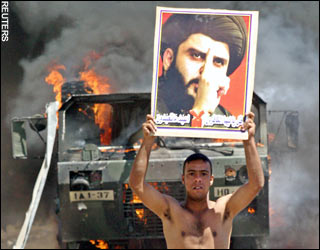
Al-Sistani's aides say that he has chosen to stay silent rather than suffer the ignominy of being ignored. Moqtada Al Sadr's stock has risen. A spokesman, Sheik Hussein al-Aboudi, says,
He meets his representatives every week or every day. Sistani only meets his representatives every month.

Muqtada al-Sadr asks them what the situation is on the street, are there any fights against the Shia, he is asking all the time. So the people become close to al-Sadr because he is closer to them than Sistani. Sistani is the ayatollah, he is very expert in Islam, but not as a politician.
Sistani's departure from Iraq's political scene and his return to his religious role signals an end to the Maliki regime's attempt to consolidate power and sell his reconciliation plan to the myriad of warring factions who are engaged in armed and deadly struggles against his regime, and against each other as well. It was Sistani who brought the thousands of his followers to the polls, forcing Bush to make good on his promise of early elections.
Cross-posted in Civil War In Iraq

Godwin's Law & Corollary

Steve Chapman, Iraq isn't Hitler's Third Reich:
Among the many innovations generated by the Internet is an axiom called Godwin's Law, which says that given enough time, any online discussion will produce a comparison involving Nazism or Hitler. So common is this phenomenon in cyberspace arguments that it also spawned an informal rule: Whoever first mentions the Nazis loses.

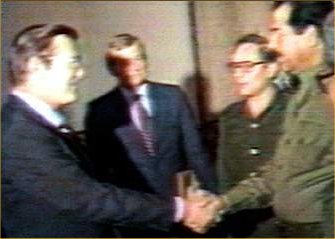
By that standard, the Bush administration is getting trounced in the debate on Iraq. Last week, Defense Secretary Donald Rumsfeld went to the American Legion convention and likened critics of our policy to those who discounted the threat posed by Nazism. The threat of "a new type of fascism," he said, is just as great as the one posed by Hitler and Mussolini.

President Bush followed with his own address to the Legionnaires, asserting that the fighting in Iraq "can be as fierce as it was at Omaha Beach or Guadalcanal," while insisting that "victory is as important as it was in those earlier battles."

The administration's top officials have been a poor guide to the future: Rumsfeld said before the war that it might go on for "five days or five weeks or five months, but it certainly isn't going to last any longer than that." They have been a poor guide to the present, as when Vice President Dick Cheney declared--about 1,000 American deaths ago--that we were seeing "the last throes, if you will, of the insurgency." And, judging from their recent forays into history, they are a poor guide to the past.

One defect in this analogy is that it's extremely shopworn. No matter how many Hitlers we stop, another appears. During the first Gulf War in 1991, it was Saddam Hussein. During the Balkan wars of the '90s, it was Yugoslavian President Slobodan Milosevic. Now it's--well, anyone Islamic who might be an enemy.

Rather than try to understand the unique challenges we face in the 21st Century, the analogizers assume they are replicas of ones we have confronted before. Such glib parallels bring to mind Mark Twain's remark: A cat that sits on a hot stove will never again sit on a hot stove, but it will also never sit on a cold one.

The supposed moral of the 1930s is that you cannot negotiate or coexist with enemies. Instead, you must fight them. Anything less amounts to a replay of the Munich conference, where Britain and France acceded to Hitler's claims on Czechoslovakia in a futile effort to purchase peace.

But we already know the analogy can be fatally misapplied. President Lyndon Johnson was guided by it during the Vietnam War. When the North Vietnamese won, though, it didn't set off a vast expansion of the communist empire. Ho Chi Minh looked like Hitler to LBJ, but he wasn't.

If the 1930s taught that you can't coexist with aggressive enemies, the Cold War taught just the opposite. Britain and the United States, which refused to appease Hitler, did appease Stalin by allowing the enslavement of Eastern Europe. Yet we were able to contain--and eventually defeat--the Soviets without ever going to war.

You don't have to take my word that Hitler is irrelevant here. The administration's own policies confirm as much. If the enemy in Iraq were comparable to the Third Reich, we certainly wouldn't be fighting this war the way Bush and Rumsfeld have fought it.

When the U.S. entered the war against the Axis powers, we drafted millions of men, raised taxes, and mobilized every resource to assure victory. When the U.S. invaded Iraq, we sent an undersized force, cut taxes and told Americans to live their normal lives. If Islamic extremists are the new Nazis, Bush is no Churchill.

In fact, the situation today is much different from the one then. Militant Islam is not one phenomenon but many. Iraqi Shiites and Sunnis, far from being peas in a pod, are at war with each other. You can't barter with Osama bin Laden, but you may be able to negotiate with Syria. Persisting with the war in Iraq is less likely to undermine than advance the fight against Al Qaeda.

Given the dire prospects in Iraq, it's not surprising that Bush and Rumsfeld would rather talk about the past than the present. But we already know how to defeat Hitler. What the administration has yet to prove is that it knows how to win in Iraq.